



Do you think anyone will ever have the nerve to remake James Cameron’s Titanic? I think about that question often, as we go through a period of creative stasis, relying entirely on things that already exist to make our new things. When that film first premiered back in 1997, it was so popular that it remained in theaters for 10 months. Audiences adored it, and it won 11 of the 14 Oscars it was nominated for. But it wasn’t wholly respected by critics: The LA Times said it “reeked of phoniness.” Time magazine’s Richard Corliss, maybe somewhat prematurely (and a little distastefully), labeled it “dead in the water.”
Nearly three decades and $2 billion later, Titanic is memorable mostly because you can still recall how it made you feel when you first saw it. That’s a special sauce. Big movies rarely make you feel like that anymore because big movies are mostly superhero movies that see scale as a shortcut for provoking awe and wonder. That’s maybe why I respect Emerald Fennell’s Wuthering Heights for striving to make something both big and poignant.
According to Margot Robbie’s British Vogue interview, Fennell’s MO for her take on Emily Bronte’s romantic novel was to make “this generation’s Titanic.” Now, this is not me saying that I think Fennell’s film is Titanic, but I do think that it will elicit that same kind of headrush in the masses who turn out to see it in theaters this week. It is a movie that feels like a movie. The kind of thing that should be seen in cinemas not because of its scale—though it is, at many points, very big—but because it promises to match that kind of swooning, all-encompassing feeling that Titanic once gave you. The sort of feeling you get when you realize that everyone in the theater is on the same wacky, sexy train. I enjoyed it so much that it gave me a migraine.
I’m of the opinion that really good films should be able to trick your body into thinking, for even just half a second, that you might be experiencing one of the most evocative and interesting things you’ve ever seen. As a director, Fennell treats romance with all the sticky ugliness of body horror, so that comes easily to her. The internet seemed to shift on its axis the moment Barry Keoghan slurped semen from a bathtub plughole in Saltburn.
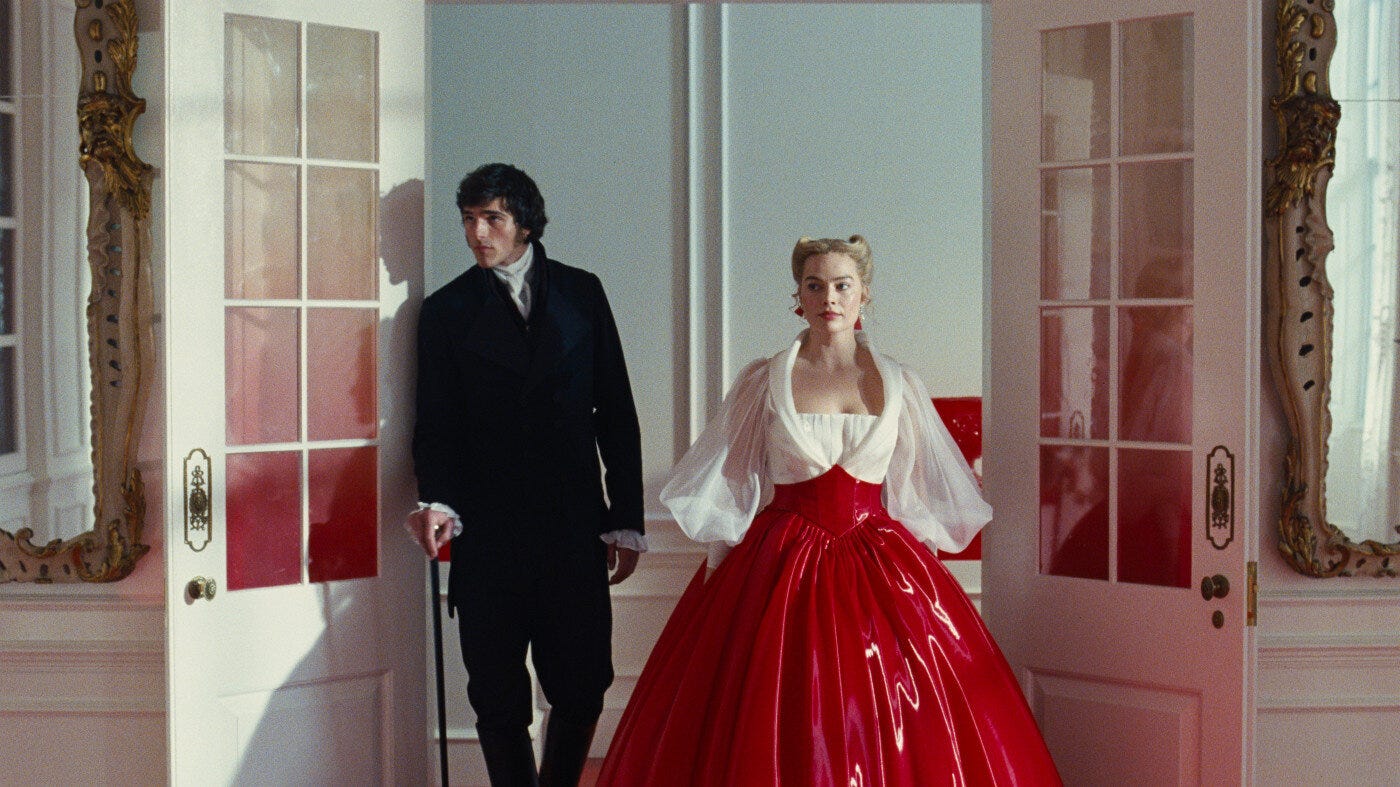
Wuthering Heights is a well-told story: Cathy (played by Robbie), the heir to an ailing estate, is drawn to her long-time companion Heathcliff (Jacob Elordi), the hot hunk of a pauper society won’t let her marry—despite lusting over him while wed to a wealthy man, Edgar Linton (Shazad Latif). From the moment it was announced that Wuthering Heights would be her follow-up to Saltburn, a film so outrageous that it pissed off as many people that loved it, it was assumed that this adaptation would be equally abnormal. But perhaps the most outrageous thing about it is how unexpectedly straight it’s played: Sure, there’s some BDSM play, and some anachronistic costumes and set design, but other than that it feels almost faithful to the spirit of its source material, even if (as in most adaptations) there’s some narrative omissions and redirects. At one point, the internet this Wuthering Heights would be filtered through the dreams of a contemporary woman. This isn’t strictly true, but it does feel like Fennell’s dream vision. When Cathy moves into the Linton Estate, the innards of the house feel like a shattered jewellery box, with iridescent walls and weird mantelpiece art sculptures. Cathy’s room is painted “the color of her sweet face”—veins, moles and all. Her gowns are made of PVC and cellophane. Our best look at it comes in a wild ‘passing of time’ montage set to Charli XCX’s “Chains of Love.” Past adaptations have been pastoral and modest, perhaps too respectful. Fennell’s version feels like it’s kicking out the corners of the screen.
After I saw it, a colleague messaged me, suggesting that the sex scenes felt exaggerated considering it’s set at the turn of the 19th century. But who’s to say people weren’t getting really freaky with it back then and just not writing it down? Early on, Cathy watches a couple have wild sex in an outhouse involving a horse bit, only to be shielded from viewing it by Heathcliff, who quietly cups his hands over her eyes and mouth. Later, she pleasures herself on the moors, reimagining the feeling of being wrapped in Heathcliff’s arms.
Which brings us to the film’s MVP: Jacob Elordi’s tongue. It’s doing some of the craziest shit I’ve ever seen in this movie. When Heathcliff talks to a woman he’s trying to entice, his tongue dances across the back of his teeth like a goldfish flailing out of water, ready to pounce. It literally leads a French kiss at one moment, and mops Cathy’s tears the next. This is the kind of semi-gross sensuality that Fennell knows how to transform into those burned-into-your-brain images.
Cathy and Heathcliff predate Jack and Rose in the public consciousness by a century and a half, but because the audience for classic literature is slim and Titanic is becoming its own tome in cinema history, it feels like a fair chunk of today’s Gen Z audience will be blind to both reference points. Maybe for them, Wuthering Heights will feel as special to them as Titanic did to a ’90s lovelorn teenager. I expect that, much like when that movie dropped, the critical consensus might be a little all over the place, but sometimes the ones we adore (see also Baz Luhrmann’s Romeo & Juliet) have to go through the ringer first before they’re appreciated. Personally I think Wuthering Heights is a movie its maker should be proud of: a hot, decadent, old school romance that bares all of its teeth.

Darling, I think you dropped the #sponsored tag here on the floor...
I'm really hoping to be so enthralled by their performance that they make me forget all about Margot Robbie and Jacob Elordi