


You experience a beautiful lapse in self consciousness when you’re at the barrier of a pop show. All of a sudden, you’re in service of the star, losing control as loud as you possibly can. To many, that first encounter is like seeing God or a mythical creature; for some, that sensation never changes.
For the last decade, photographer Alexandra Waespi has had privileged access to the pit, her camera facing the star on stage. But then she did a 180-degree turn and looked behind her: That ocean of starry-eyed bodies all of a sudden became really interesting.
So she started photographing them too, resulting in a photo series known as “Front Row Feelings,” which we’re debuting exclusively on i-D. Waespi has been collating these images for the last four years, at shows for musicians with largely young female fanbases, like Rex Orange County, and, most recently, Harry Styles’ marathon run at Wembley Stadium.
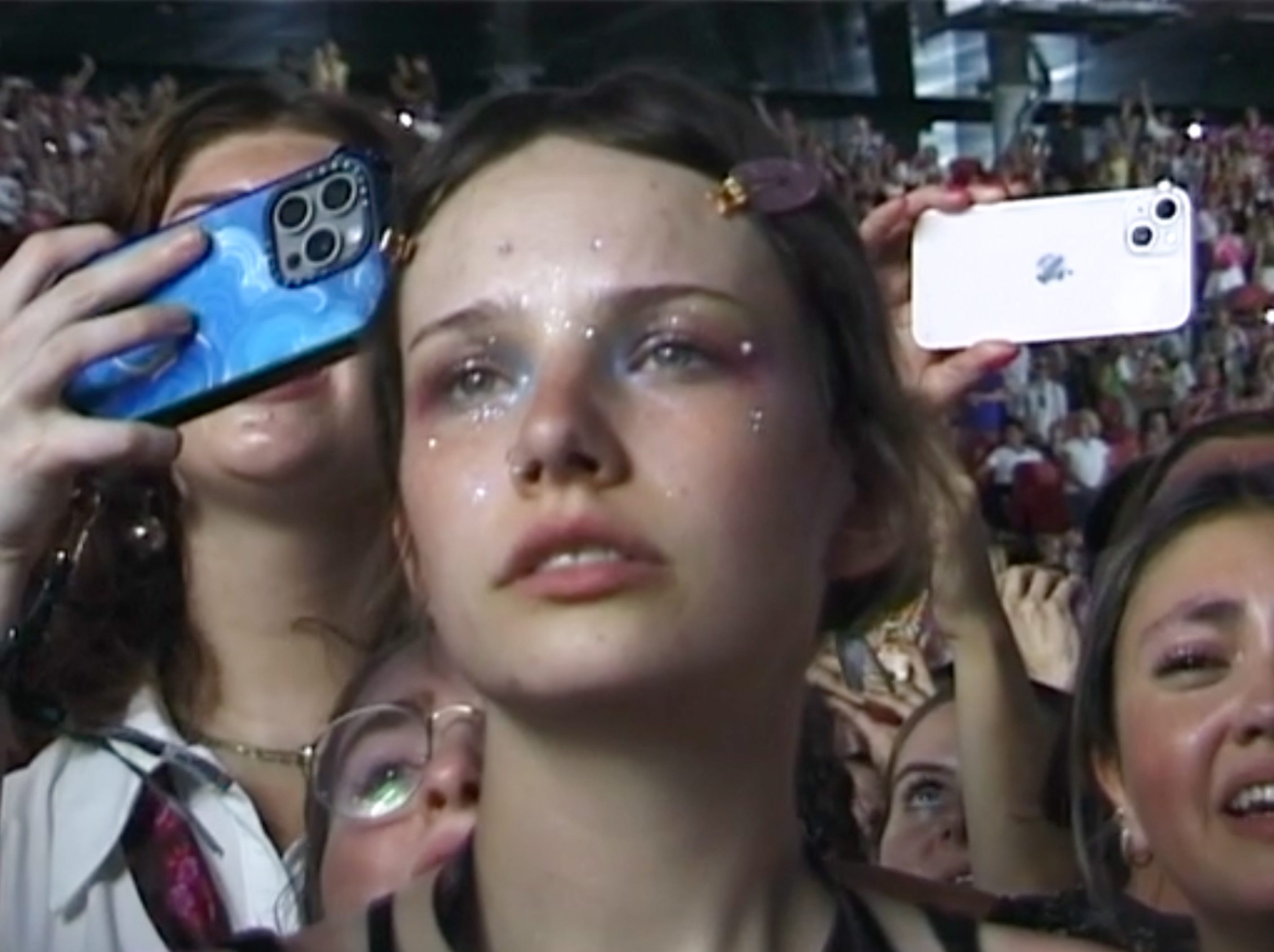
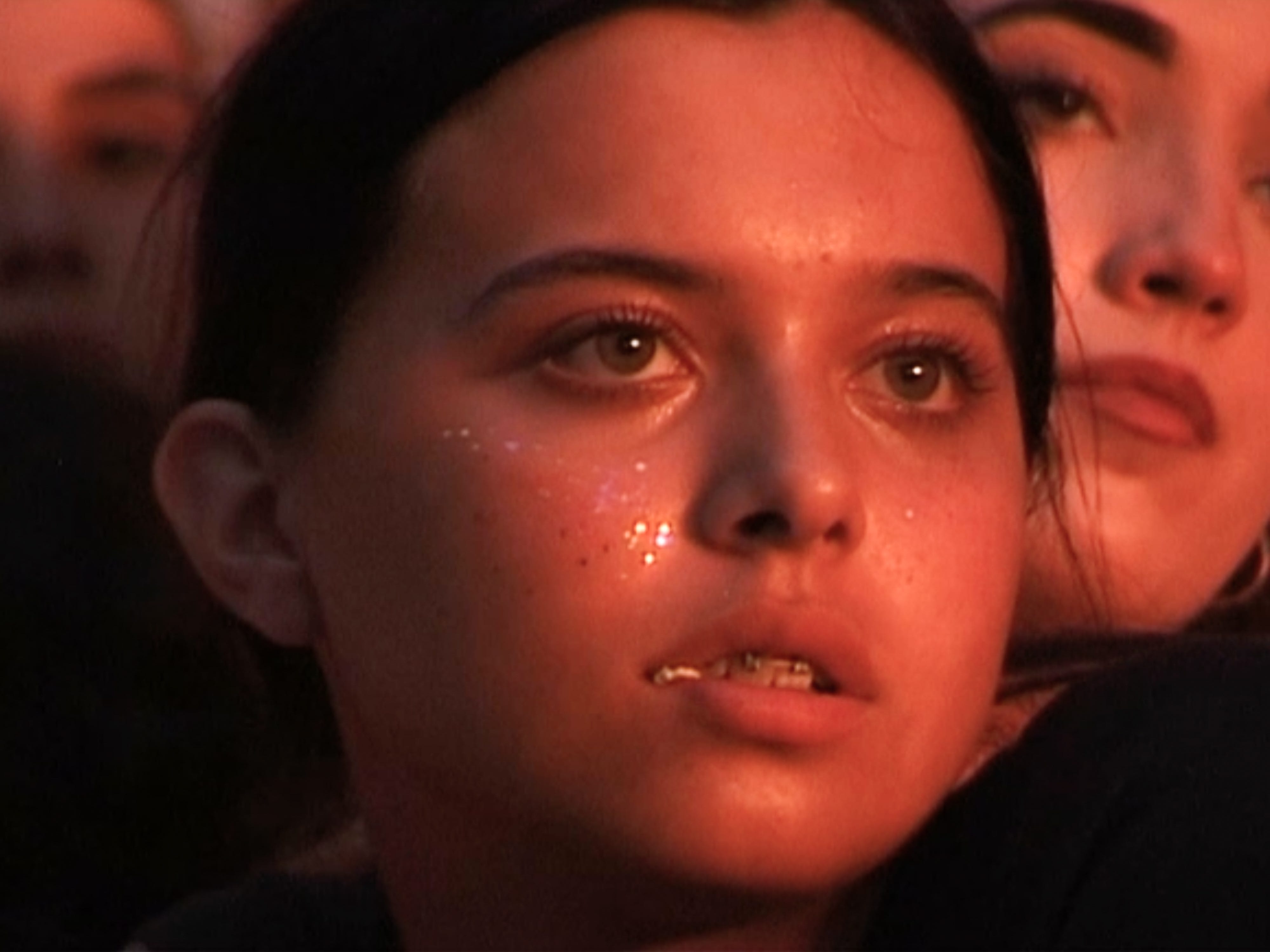
The pictures she takes feel like they’re lifted from dreams: lurid in color, light reflecting off of glitter and tears, faces contorted into a distinct shape that somehow suggests both yearning and sadness. Here, Waespi tells us about her experience taking the pictures, and how she found herself in her subjects.

DOUGLAS GREENWOOD: Can you start by telling us where this project began?
ALEXANDRA WAESPI: The first time I started touring, I was photographing Adele on the 25 tour. It was my first time witnessing first hand the almost religious nature of fandom. I was amazed and perplexed by it all, the way it felt like a form of worship. There’s an icon, devotion, and a pilgrimage towards this overwhelming collective experience.
After years of touring with musicians, I started to become more curious about what was going on behind me, rather than what was happening on stage. I began watching the fans intently. One image I took kind of kicked it off for me: there was a blue light from the stage washing over the face of a girl leaning over the barricade with her head in her hands… The blue seemed to emphasise the melancholy of the moment, and I couldn’t stop looking at it. After that, I kept searching for more of that feeling.
Can you speak to how people respond in those settings? Do certain fan bases go crazier than others?
Yes, in my experience certain fan bases do go crazier. I’ve found there can be a different energy with some artists, particularly when there is a guy on stage and girls in the crowd. There is more longing and desire, like they’ve been waiting their whole life for this moment. But it only lasts a couple of hours, and then it is over, then there is this strange mix of heartbreak and ecstasy that creeps in. Then the waiting starts again. I suppose it calls back to the times of Elvis and Beatlemania in a way. Not much has really changed.
I find so much beauty and joy within the community of fandom. There is a collective care and kindness. If you’re a committed fan and have been waiting since the middle of the night, then you are automatically in the inner circle of devotees; you speak the same language. My heart is always warmed when I go to the front of a queue outside a venue (and mind you they do this in any weather, I’ve seen them sit through snow storms!) and everyone has made friends with each other. Then you see them in the front row when the show starts, filled with anticipation because they have been waiting outside for 12 or even 24 hours.
What do you see in these fans’ eyes when you photograph them?
Longing, wonder, heartbreak, hysteria, disbelief, desire, hypnotism, euphoria, collective joy. Even if there are 90,000 people in one space, I am looking to connect with one person’s experience for a fleeting moment.
I care about these girls and in a way I see myself in them. Even if I wasn’t ever a fan in this way, I see myself as an emotional teenager. Everything felt more dramatic at the time, more intense. It’s also interesting to me how we as humans have so many similarities in the way our bodies react: there are a lot of hands on the face or covering the mouth, the way our breathing changes, our brows furrow, and our eyes start to well up. With this project, I’m trying to preserve something ephemeral.
What about this project speaks to your wider work?
My approach can be quite meditative. Even though there is heightened emotion in the air and thousands of people around me, I am looking for quiet moments amongst the chaos. I think that’s the thread that runs through all of my work: whether I’m in someone’s bedroom, photographing roses on the streets of east London, or standing in the front row of a stadium.

I almost feel bad for Charli xcx, whose Music, Fashion, Film sort of felt like a fumigation technique to shake off the looming pressure of Brat. It turns out this new album is just as gnarly and impressive as its predecessor, blessed with strong reviews (and a bad one from The Telegraph? I think she’ll live.) Well deserved.
I rearranged my trip back home to Scotland to make it to the David Wojnarowicz show at Glasgow’s Modern Institute, subtitled some day this will all be crumbling ruins. Composed of his photography, large scale artworks, sculptures, and video, I found it to be so powerful. The Modern Institute is a derelict townhouse with little fabrications or furnishings. Wandering around it felt like stepping into the crumbling Christopher Street piers Wojnarowicz frequented. Apt. It’s only open on Friday, 11-6, until August 22. Change your plans for it.
