


In college I once walked in on my shirtless housemate filming himself attempting the renegade. Scrambling for his shirt, he groaned, “It’s just a joke.”
It was 2019, Donald Trump was just impeached, NASA took its first ever photo of a black hole, and Charli D’Amelio had just started posting in earnest on TikTok. Skeptics felt the Chinese-owned app posed a national security risk. Cynics dismissed it as an app for dancing teens. Midwit lip-sync platform Muscial.ly’s next of kin (literally—TikTok’s creator ByteDance bought Musical.ly only to sunset it, merging all users into TikTok), the app was awash with gyrating teenagers mouthing along to 15-second audio clips. There was a sense of possibility on the nascent platform. Anyone was just one viral video from being a homeowner.

In the years since, TikTok has developed into a significant cultural incubator for comedic talent, new music—this year NPR joked that “The best new artist Grammy goes to … TikTok”— fashion trends, and marketing strategies. (If I ever have to read another Arby’s comment on a video I’m going to go postal.) Competitors like Meta and Snap. Inc scrambled to launch analogous features on existing platforms. TikTok has surpassed all expectations…but what happened to those dancing teens? Was it all a joke? Or will the TikToks we made along the way actually stand the test of time?
TikTok is a platform defined by dance for a reason. Unlike the horizontal landscape of YouTube, TikTok’s vertical confines and audio focused ethos provide fertile grounds for imitable dance. In that proximity is a tender promise: Without training or rhythm, you too can renegade!
The renegade, a dance created by then 14-year-old Jalaiah Harmon, involves a stationary but complex series of snaps, claps, shoulder jerks, pelvis thrusts, and head shifts. It combines existing movements like the “Woah” and the “Dab” to K Camp’s song “Lottery.” It is a dance perfectly suited for French mimes.
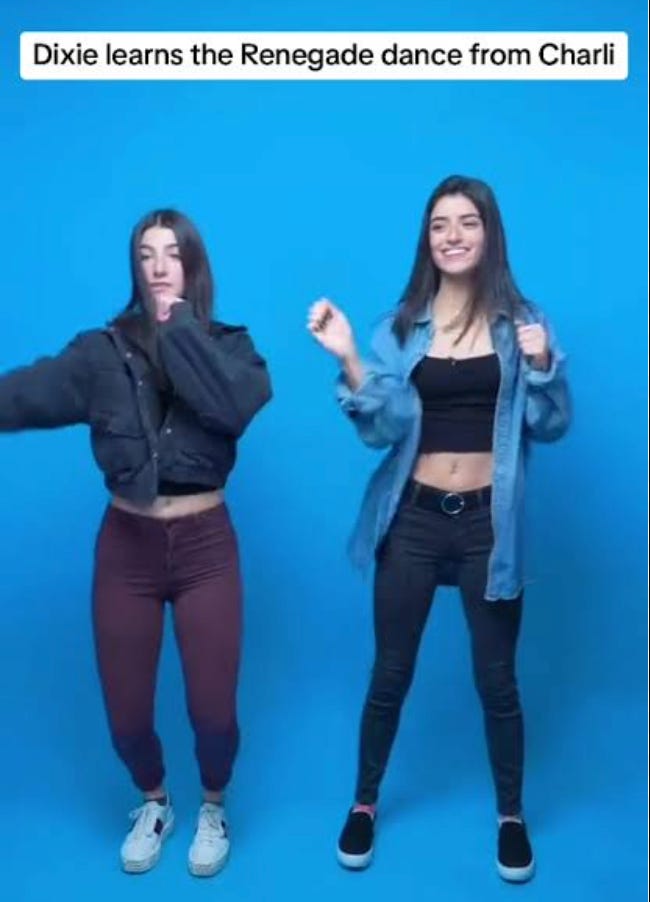
Over 29.7 million users (and one, as of this past weekend) have attempted the renegade. Requiring only mobility within the perimeters of an iPhone screen, the renegade can be completed even in the most suboptimal conditions: violently hungover or even potentially post-op after a knee replacement. Critics of TikTok dance have pointed to its static nature, the magpish-ness of its accolytes—white influencers receiving the financial windfall from dances created, uncredited, by people of color—and on a more aesthetic level, how totally cringe it can be. Within the dance community, some worry that TikTok dance distracts from technical proficiency and artistry.
The earliest known documentation of dance comes from paleolithic rock paintings. I bring it up to illustrate that dance is one of the oldest possible artistic mediums, followed only by the urge to document it. The impitus to dance and to share dance is woven into our DNA—dance fosters connection, improves memory, and strengthens neuronal connections. It has had various religious inspirations, it’s been pagan, it’s caused unending controversy, and notably, it’s a form that’s constantly evolving with fads that are often seen as low art until, either through institutional recognition, popularity, evolution, or simply sticking around long enough, they ascend.

I absolutely loathe to quote anything backed by libertarian thinktank the Cato Institute BUT, and I hate to break it to you, “Every New Dance Used To Be Scandalous.” When the Viennese waltz arrived, it was felt to be so morally indecent that it was declared literally unhealthy…until, of course, it became popular enough that German fashion magazines reported, “Waltzes and nothing but waltzes are now so much in fashion that at dances nothing else is looked at; one need only be able to waltz, and all is well.” The pattern repeats, whether it’s twerking or hitting the woah. People turned their noses up at breakdancing too. In 2024 it was at the Olympics (never forget Raygun). During the 16th century in European courts, the energetic Galliard inspired the infinitely smoother jig Tourdion. In 1933 University of Chicago (I can’t mention UChicago without my favorite quote of all time, when A.J Liebling called the University, “the greatest magnet for neurotic juveniles since the Children’s Crusade”) student Katherine Curtis developed American style synchronised swimming by blending acrobatics and German water ballet with music. Contemporary dance is a mixture of ballet and jazz. History offers endless examples of overlooked art forms eventually transforming their genres. Impressionism, Jazz, Hip-Hop.... The beauty of dance is that it’s a universal language; It’s undeniable. To dismiss TikTok dance because it’s accessible, fun, and popular would be a mistake.
Some of our great TikTok dancing teens have parlayed their shimmies into long-term careers. Addison Rae is a bonafide, Grammy-nominated pop star. Charli D’Amelio danced on Broadway. Now 20, Jalaiah Harmon dances and influences 685k Instagram and 3.3 million TikTok followers. The influence of TikTok dance—defined by short choreographed bursts, incredibly literal adaptations of each lyric, and vivid facial expressions—has already flowed fully into the mainstream. Watch Grant Gilmore’s work and witness a style developed by a close camera, or Zara Larsson’s Midnight Sun dance gimmick which seems geared toward virality (one lucky audience member gets to go on stage and do “the dance” with her). Remember the dance craze around Charli’s song “Apple”, which led to another tour gimmick, someone being the “Apple Girl.” Or the sudden abundance of dance forward pop stars—Tyla, Tate McRae, Adela. Dance is more popular than ever, in part because of it’s abundance on social media. Dance may have changed TikTok, but TikTok is also the latest entry in the history of dance, and in that, like it or not, it’s forever.
Loving dance week! Thanks for this piece.
Also, wanted to share a story that may be of interest; I published this recently with Harper's Bazaar about ballet and the aging brain: https://www.harpersbazaar.com/culture/features/a73218995/ballet-alzheimers/