


There’s a point during Oscar season so predictable you can smell it coming: the formation of a villain. Last year’s designation was easy, because the villain was of her own making: Ms Karla Sofia Gascón, the quite racist actress who played the titular diva in Emilia Pérez, and also appeared on Masterchef once. That film was beloved, for some unhinged reason, but pretty much torpedoed most of its awards chances after Gascón’s problematic tweets surfaced. She hasn’t really been seen since—apart from on the cover of Pop magazine. Her stan accounts stopped tweeting in October 2024.


This year, that villain is Hamnet—already a winner of Best Motion Picture - Drama at the Golden Globes. You know what it is by now I’m sure, because you’ve seen the billboards on the subway and the trailer in your Instagram ads. It’s the story of William Shakespeare, his wife, and their son that died, thus inspiring Hamlet—which you’ve also probably heard of. It’s been around for a while.
This anointment is despite the fact that the film features no cancelled actors (someone search 12-year-old Jacobi Jupe’s tweets STAT), deals with a distinctly unproblematic subject matter, and has sailed through its screenings at festivals with mostly fawning critical praise. So what’s the problem?
A fair question. Personally, I think it’s wonderful: a formally interesting period drama about where we put overwhelming grief when it spills out of us. Jessie Buckley cements her position as one of her generation’s finest actresses. Paul Mescal, consistently excellent, is so dedicated and impressive that he even has a little fuck ass earring! It compelled me and then it crushed me in the final minutes. I’ve recommended it to everyone.
But plenty of people disagree. This week, i-D contributor Patrick Sproull wrote an op-ed for The Independent, stating their belief that Hamnet was “artificial,” and “a blunt spade designed to whack you over the head until you weep from the pain.” But most contentiously, they considered it emotionally manipulative, and a work of fan fiction—a reference to director Chloé Zhao’s old hobby before she made movies. Both observations were dismissed as misogyny online.
They’re not alone in thinking this. Beyond Buckley’s performance, for which she’ll win an Oscar no doubt—we don’t endorse gambling but if you fancy making a meager profit, that’s money on the table—I’ve heard plenty of people call Hamnet lethargic, or criticize the final needle drop which drags you towards tears. These are all creative criticisms, but on X, film fans have quickly embraced all negative reactions to generally celebrated films as a form of bullying the filmmakers. Responses to Sproull’s piece, which currently has about one million impressions on X, are personal in return: “a psychopath devoid of human emotions,” “pick me loser,” and “evil twink” are some of their new names. Sproull has embraced the chaos too:
Douglas Greenwood: Even in the midst of this, was it nice to hear people still think of you as a twink?
Patrick Sproull: Yessss, it was so affirming! And the people saying I was too young to experience significant grief? Loved it! [Editor’s Note: Sproull is nearly 28 and their mom is dead.]
Anyway, is any of this all that deep? Do we need to be going after writers—or anyone, really!—for expressing an opinion about a movie we don’t agree with? And why have we developed this resistance to hearing people trash talk about things we love? Where did it come from?
The writer Alice Moody described this as “anti-negativity rhetoric” on X. “Engaging with someone’s critique of a work is pointless when you can just call them a meanie bully,” she wrote.

“So much of it comes down to the idea that liking a movie has to be congruous with who you are as a person, and so anyone who dares to speak ill of that, by proxy, takes it as an attack on themselves,” Moody tells me. “It’s a deeply unhealthy mindset that allows very little room for lively, interesting conversation.” She thinks this development, which seems to be mostly reserved for places where intense stan culture propagates, is a symptom of just that: Our renewed desire to go to bat for things, people, movies that we love, in an almost parasocial way. “You can’t just say ‘I disagree with you and I’m mad,’ so there is this faux-justification of lashing out,” she adds—which is where the bullying accusations come from.
Is there a way we should process people hating what we love instead? “Don’t be a baby about it,” Moody says. She’s written this very good Substack on the subject of contrarianism here.
I’ve started to wonder if such backlash, and support in response, is maybe the perfect way to get people to watch your movie anyway. Across-the-board praise can be a curse when others come a little later to the party (as the king of hyperbole, I’m a prime perpetrator of this). A mostly negative consensus? You’re getting Ella McCay-ed: Banished to the depths of Disney+ after making $9 in movie theaters, never to be seen again.
Sometimes that person who can’t help but bitch on social media is actually doing your favorite movie a favor. Hamnet is gonna be fine. Chloé Zhao will make more movies. And maybe one person will decide to see it even after reading Sproull’s hatchet job. If they disagree with Sproull’s take, their experience will be twice as sweet. If they agree? Hey, at least they know they’ve got a friend out there.

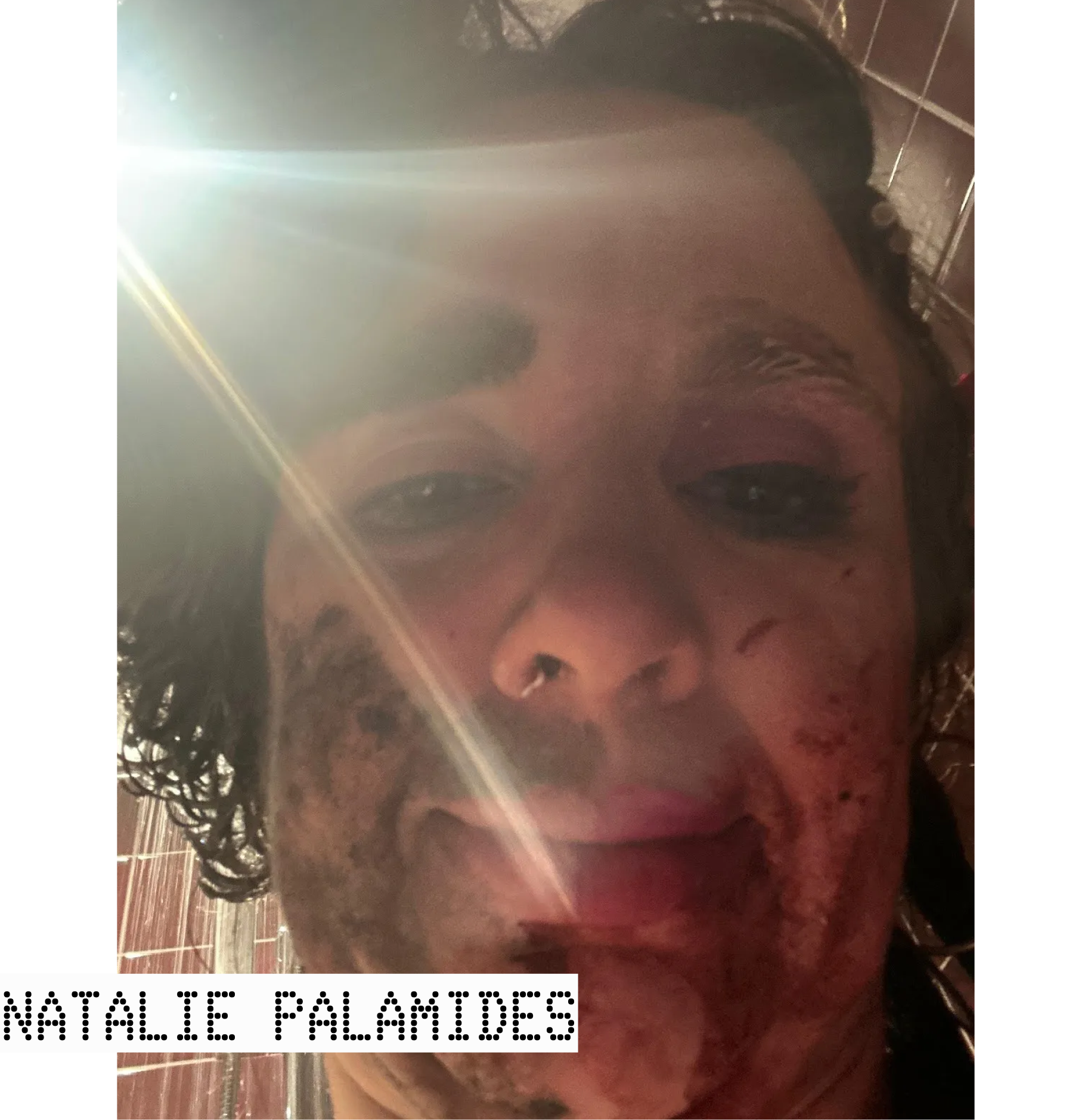
Is that Pitbull? No it’s the other Mr. Worldwide, actor and comedian Natalie Palamides. She’s spent the last several years taking Weer, her crass and brilliant rom-com play in which she plays both love interests (one on each side of her body), all around the globe. First it was at the Edinburgh Fringe, then LA, then it came to London, then it opened A24’s Cherry Lane Theatre in New York, and now it’s back in London for one week only. I only really laugh at things on my phone these days so it’s quite nice to look up from it and see someone being funny in the real world too. Get your tickets here.
I asked her: What’s the embarrassing event from your life that you remember when you’re just about to fall asleep at night?
“When I was a teen, on a family vacation at the beach, my cousins and I were playing a very physical game of American football, and I was tackled in the sand. I went into the ocean to wash the sand out of my bathing suit and thought I had tucked all of the necessary bits back into my suit. As I exited the water, I heard my dad shouting something at me over and over, but couldn’t make out what he was saying—our spot on the beach was pretty far away. I was confused because it just sounded like he was saying my name, “Nat, Nat, Nat, Nat.” “What?” I said, but he just continued repeating the same thing and I was even more confused. When I finally reached our blanket, exasperated I said, “What is it?!” To which he finally clarified, “your nipple’s hanging out.” I looked down and lo and behold my nipple had been flying free for the entire trek back from the water. He wasn’t saying “Nat,” he was saying “Nip. Nip. Nip. Nip!” My soul left my body as I realized and I whipped that bad girl back into my suit. Dad looked to the family next to us and shrugged—they shared a laugh. My cousins couldn’t stop laughing and it’s been part of the family lore ever since.”

I finally know someone who’s seen Wuthering Heights and they won’t tell me anything about it!!!
Our next one of these will likely be a breakdown of the Sundance Film Festival’s best bits. My favorites from last year’s fest were Sorry, Baby and Peter Hujar’s Day.
Sweden is cooking once again. New Robyn, new Zara—and the return of Tove Styrke!
And this is how I found out that Karla Sofía Gascón was on MasterChef.
I think the fact that it’s called “Hamnet” and not “Hamlet” also sends the haters spiraling