


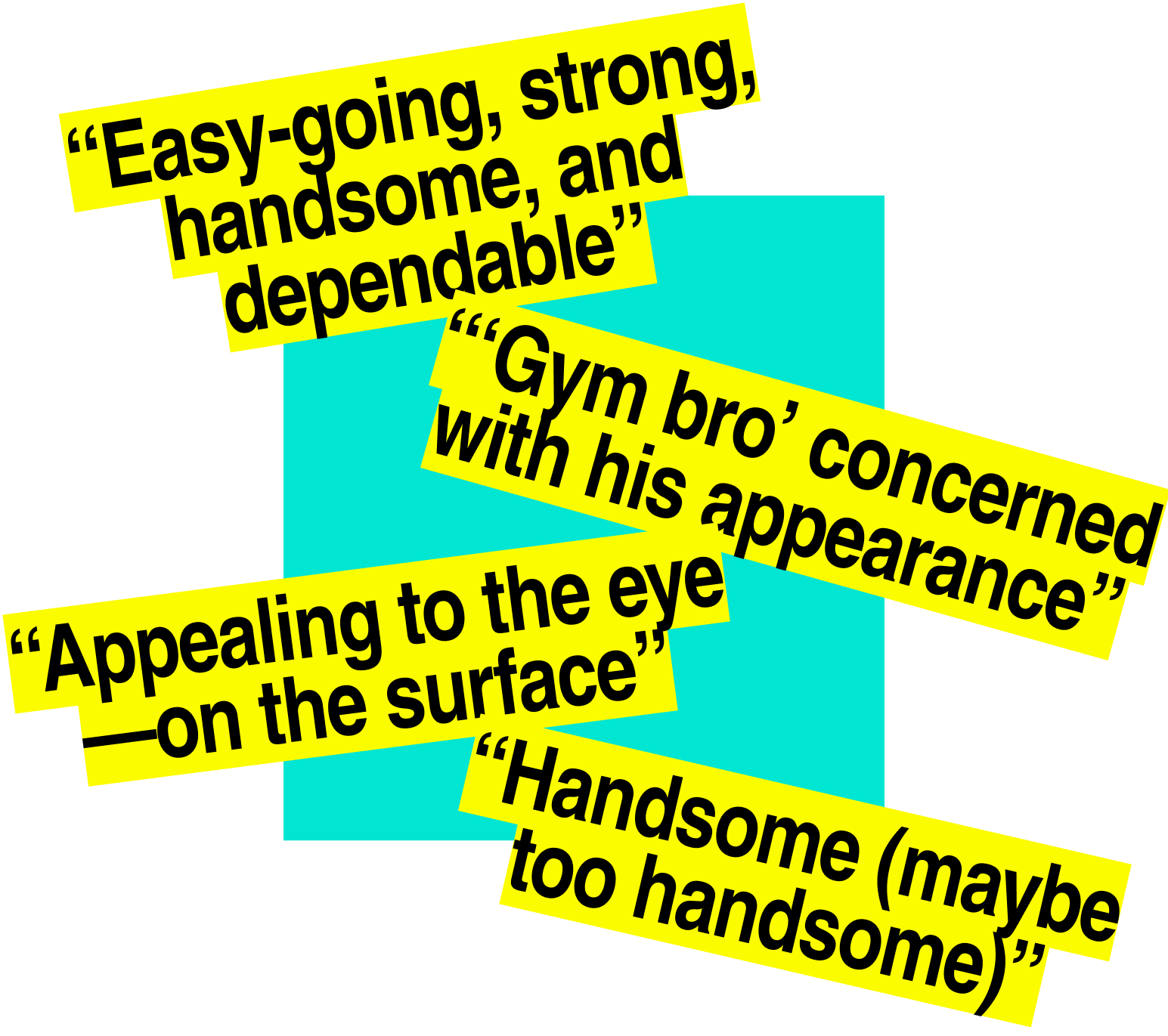
Richard, an admittedly good looking English actor in his early 30s, is talking me through the character descriptions of the parts he’s been asked to audition for. “That’s just the past two weeks,” he says. “All four are about my looks.”
He is, on paper, perfect for these parts, but he has bigger ambitions that casting directors can’t see past. The parts he wants to play—ones that reflect his working class Northern upbringing, for example—he never gets seen for. “I have lost a few jobs because I’m too attractive for the role,” Richard says. “Or even worse: I’m more attractive than the guy playing the romantic lead.”

Yes, hotness is an impediment for fresh stars in the acting world. Most people don’t want to be movie stars anymore, and so the general landscape of hotness has adjusted with it. “Real” looks are back. A snaggle tooth, crooked nose, or unique body type have all become an integral part of the charm of the New Hollywood class. Appearing “imperfect” means that an actor can slip into the interesting characters they audition for. But for the conventionally hot, pristine looks now stand in the way of a good on-screen job.
That’s a big change in the industry. For most of the 21st century, the word Hollywood itself has been used as a catch-all term for ultimate beauty: Hollywood smile, Hollywood hair. Even a decade ago, the likelihood of mainstream success—outside of genres like comedy, for example—was contingent on people finding you dazzlingly attractive. But for a new generation of actors auditioning in the late 2020s, getting your foot in the door is becoming difficult when people can’t see past your beauty. “My best friend helps me self tape, and she says ‘Stop trying to look pretty,’” says Tessa, an actress in her mid-20s. “I’m not, I’m just standing in front of the camera. I may be blond with big tits, but I can also play a dowdy brunette with a jumper on.”
Her daily appearance has led her to some crushing, misogynist feedback: She’s regularly considered for “the whore” or “the other woman,” she says, “because of my hair color and perfectly symmetrical face. Most characters need to blend in, but I look like a lead, not an ensemble.” Tessa is not established enough to be a lead yet. But Tessa is too distracting in her beauty to be part of a wider cast. So she’s often stuck in limbo.
It would be ignorant to suggest that Hollywood has a dearth of conventionally attractive stars. Sydney Sweeney remains one of the most bankable of all (to Tessa, she’s the blueprint), and the boys of Heated Rivalry match that level of looks-led success.
The success of the Heated Rivalry hotties is less industry standard and “more so a symptom of Hollywood constantly wanting to make a new face explode rather than wanting legacy careers,” says Paul, a young actor who often reads for teenage parts. It’s a problem that feels almost exclusive to streaming shows. “The new star of streaming has been some young guy designed to make the girls go crazy for a year,” Paul continues, namechecking both the Heated Rivalry boys and the stars of the Ryan Murphy Menendez Brothers show. “They all got those jobs because they were hot. So that’s proof [that being beautiful] helps.”
But being positioned as a plucked-from-nowhere heartthrob also affects most actor’s longevity in the industry. Plenty of our teenage crushes—Desperate Housewives’ Jesse Metcalfe, Chad Michael Murray, even Zac Efron—were boxed in by their image and, despite their best attempts, couldn’t really forge grown-up careers. Few casting directors will let himbos go normie.

That’s not to say it never happens. Sydney Sweeney gave her best performance to date when she dressed down and wore next-to-no makeup for her turn in Reality. You could rattle off dozens of female Oscar winners, like Charlize Theron in Monster, Nicole Kidman in The Hours, or Marion Cotillard in La Vie en Rose, who won their statues for doing an unflattering transformation, shedding their sense of vanity.
But if you’re, like, Abercrombie hot, getting a role in the first place—never mind one that gets you taken seriously—feels like a much trickier task. “I’d quite like to do something extreme,” Paul says. He’d gain weight, grow facial hair, or shave his head for a part that warranted it. “I think it’s quite magical to be given the opportunity to see how you would be in a different body.
“It’d be great Oscar bait,” he says.


I take issue with queer popstars who purport to be a part of the seedier side of our culture in their music but, in reality, are boring hermits. You can vulture your own culture!!! Tsatsamis, the Greek-British hot pop gayboy, makes unabashedly slutty songs, and I love him for it. I saw him play a pub basement and now he’s tearing up London’s Village Underground next month. <3
I asked him: What are your thoughts on dairy milk versus plant-based alternatives?
“I used to be oat milk all the way for a few years, but then saw a TikTok about how much it spikes your blood sugar and can make you crash. At the same time my friend showed me how many additives are in the barista versions that I was using, so I’ve gone back to dairy. Not that I don’t put worse things in my body, but I’m very impressionable.”

Nicolaia’s deep dive into the sex recession is an i-D story for the ages.
Speaking of sex, Grindr’s problematic stronghold on the gay dating app world is being threatened by a new, encrypted hook-up platform called meetmarket. Will it beat it?
Speaking of gay stuff, a friend going through a (hetero) breakup was consoled by his discovery of the song “Being Alive” from the musical Company. Sondheim’s still got the girls shaking and feeling seen. That’s power.
And apropos of none of the above: I wanna know people’s porridge (oatmeal) toppings.

I, too, have left oat milk in the past.
As for porridge toppings…a big spoonful of nut butter (peanut or almond, typically), banana, berries (usually raspberries or blackberries), chia seeds, cinnamon, and if I’m feeling frisky, agave.
Big fan of this milk q