


Liana Satenstein is New York City’s preeminent fashion archivist and seer, able to predict the return of the YSL Mombasa bag, dissect the trend towards “nipple heels,” and summon out magical nuggets from the past that will be relevant in the future. This spring, we let her loose in i-D’s archive to see what she could learn combing through 45 years of issues.
For the past few weeks, I’ve been glued to my computer screen, jumping in and out of the digitized i-D Magazine archive and its winking covers. I’ve been combing through every issue from the seventh, 1982 pop art-inflected, scrawl-dribbled fanzine founded by Terry Jones to a Paolo Roversi black-and-white lensed cover of Naomi Campbell from 2019. The plan, I’m told, is to release the archive to you all later this year.

Some of us were there at the beginning—or the middle. There are many issues of i-D from my youth that I remember marinating in the international magazine section in Barnes & Noble. A snarling Lindsay Lohan from spring 2006, busting out of a lamé, ruffle-trimmed dress. Rihanna, glowing, from pre-spring 2009. Mariah Carey beaming in a bikini from June 2008. A little tagline floats next to Mimi’s head, “Put yr stunna shades on for Ice Queen, NADJA Swarovski!”
When I’m researching, say, an It bag, I need to submerge myself in every pocket, fondle the zipper, and smell the innards. I enter this realm, not by touching the physical bag, but by drowning myself in archives. I need to know everything about it, even if it involves contacting the PR associate who was promoting the carryall at the time. Even a mere It bag, like the Celine Boogie, the Fendi Oyster, or the Balenciaga City, is never just an It bag. To really understand the essence of an It bag (and there is one), one needs to see how many editorials it was featured in, who photographed the spread, and who the magazine’s accessories director was. That little red-hot It bag reflects what was happening in fashion–and what was happening in the world. While we can’t bottle a moment, an archive is a way for us to at least understand the moment.
Going through a digital archive is the next best thing to luxuriating at a desk at Library180, flipping through each ancient magazine by hand. Or maybe the sensation of clicking through the endless archive is akin to cracking open a fresh one at Climax Books. But these spots are in New York City, which is far for many. What is a fashion-curious kid supposed to do stuck in a small town, hovering on the border of New Hampshire? Alone in Kalamazoo, Michigan? Access is often cut short.
And even if you can get to the Library180s or the Climax Books of New York, let’s not forget that old issues of magazines can be expensive! I think a lot about myself in high school in nowheresville, Massachusetts, hypnotized by editorials shot in Moscow or Paris or Shanghai. It was so hard to get my hands on physical magazines: I saved up my cash bussing tables and begged my boyfriend to haul me into Boston so I could go to a magazine stand or a used bookstore. And when I didn’t have a physical copy on hand, I spent hours on The Fashion Spot or LiveJournal looking at shoots.
But even those prized photographs fade from the internet, whimpering away with each deactivated image-hosting site, morphing pages into a graveyard of broken links. If you are lucky enough to find a rare magazine tear online, the image is often rogue, an island separated from the rest of the pages and floating alone in the ethers of Tumblr, Pinterest, or Instagram. The image exists alone with no information about where it originated. In this world where photographs sans provenance are circulated on social media, we often don’t know the makeup artist, the hairstylist, or the fashion assistant. Without appropriate credits, these images lose a layer of meaning.
Today, information has become currency. Even the tiniest facts can give birth to full articles. The rarer the spread and the rarer the quote, the more conversations get started. How many times has someone spun a whole piece out of cobbled-together interviews and tidbits from the internet? It’s a beautiful thing.
i-D has always been a magazine for the hungry youth. It’s for the people whose beds are surrounded by cairns of magazines ready to topple. For those who organize them by date, type, and country. Who tab the pages with sticky notes in different colors! For those who make friends from across the country, thanks to a random fashion forum, and can talk about one Kate Moss photograph that struck them to their core and changed their lives. As for people who have worked in magazines, are jaded, and have seen it all, why not bring those raw feelings to life again with a bountiful archive? Why not democratize the thrill of discovery for all? Information is an elixir to boredom and stagnation, and it should be shared, and it certainly should be free.
Here are some things that I liked from the archive!
1. Rachel Weisz on the cover of i-D in September 1987, wearing bunny ears
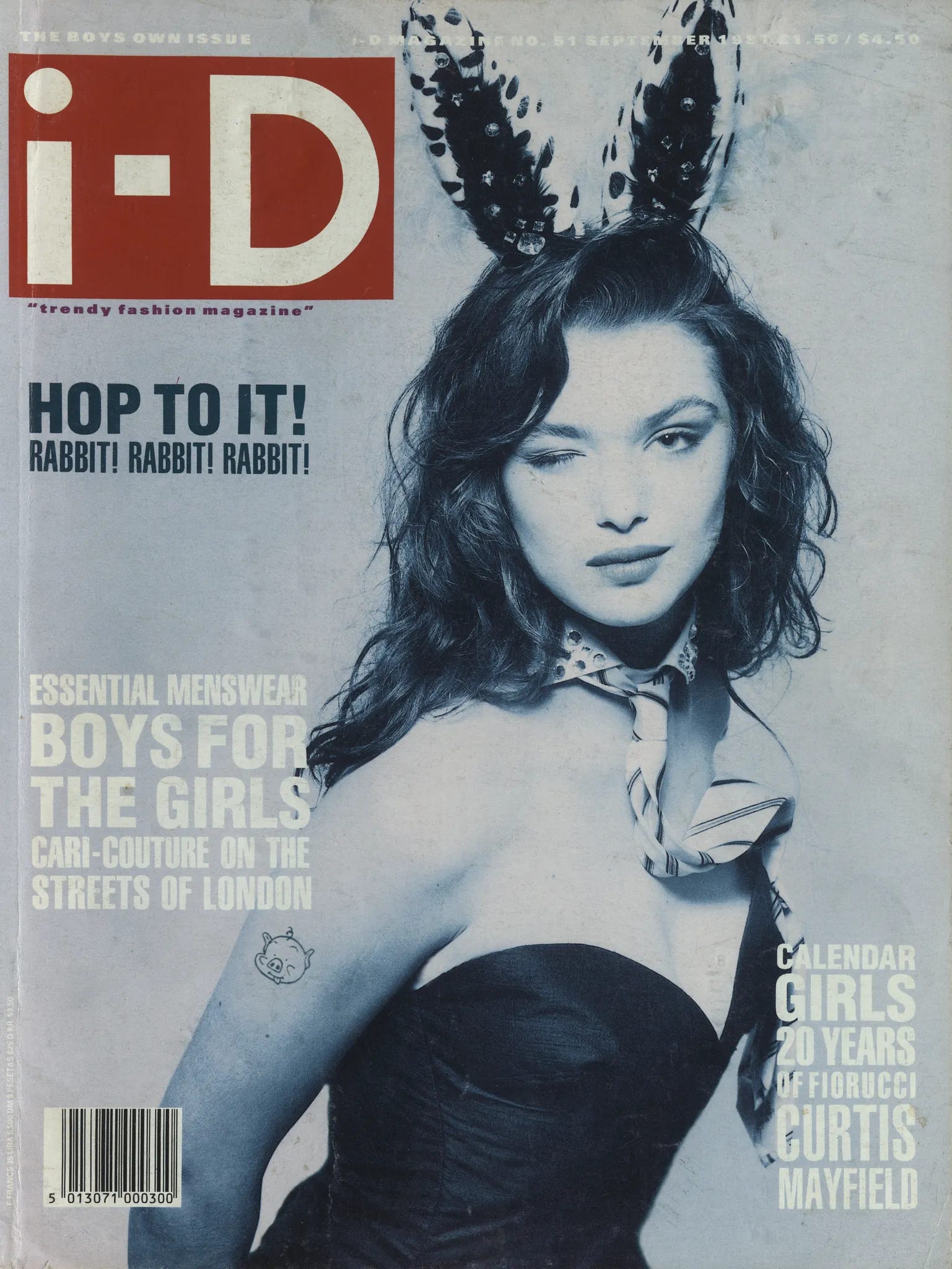
The image of a plump-faced, sassy, winking young Rachel Weisz as a bunny on the magazine cover is forever Tumblr-versed. At the time, Weisz was only 17 years old, having completed her “A Levels in Art History, French, and English”, intending to study Drama at the Lee Strasberg School of Method Acting. She’s fun. “Men Only magazines make me want to have a wash but bunnying for i-D could have its rewards,” she tells i-D in a minuscule snippet on the credits page.
Also, fun fact: The photographer of the shoot Kevin Davies, tells i-D that the piggy smiley face on her left bicep was drawn on after the shoot by then editor-in-chief and i-D founder Terry Jones. (I said: “Oh, he drew it on in post,” and Davies responded with: “If you can call it that…”) Also, I love this part: The actress’s name is spelled incorrectly as Rachel Wise…in print! Life was so free.
2. The advertisements
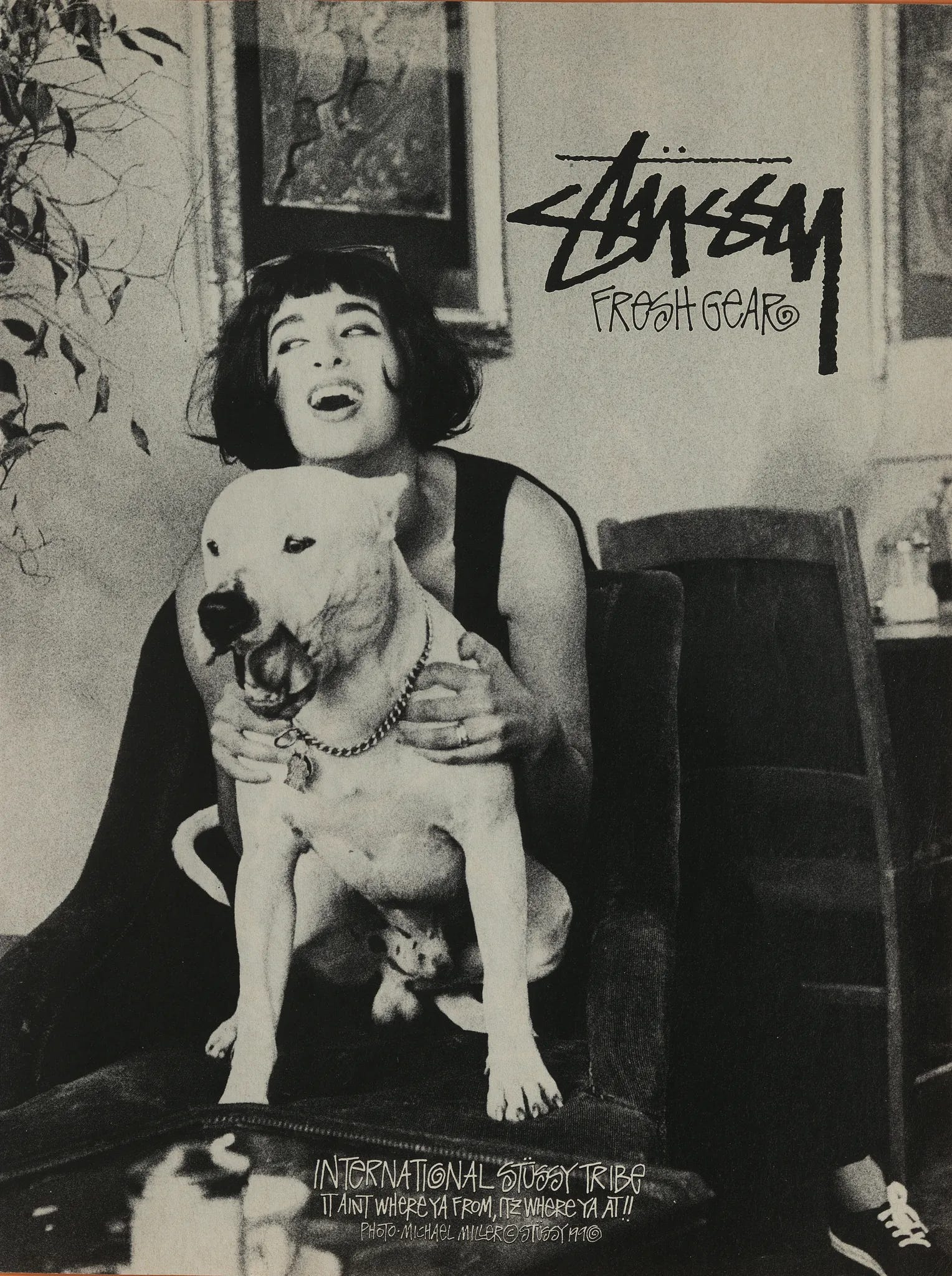
I am a Vogue archive diehard, and I could happily illustrate campaigns in the magazine from 1997-2001 as if I were an orchestra conductor. But as for the advertisements for i-D magazine? That’s a whole different ballgame. Youthful. Experimental. This is where creative directors let their freak flag fly. Every campaign is like a shivering atom of energy waiting to pop out of the page. In a September 1992 issue, there is an incredible Levi’s campaign where it’s just hazy images of where people plop their jean-clad asses: chairs, benches, and motorcycles. In May 1999, the Calvin Klein ads are sexier, raunchier: Christy Turlington is all curves and aphrodite in a white cotton stretch bra and matching panties, smoldering in all of her smoky eye glory. There’s a Rorschach test image of a woman from Nike with her limbs and head replaced with a splattering of ribbon strokes, kicking in the brand’s Fit support tank and gym capri from June 2002. Oh, and Stüssy fans: You’re in luck. The archive is teeming with ads.
3. People were having fun… even the accountant!
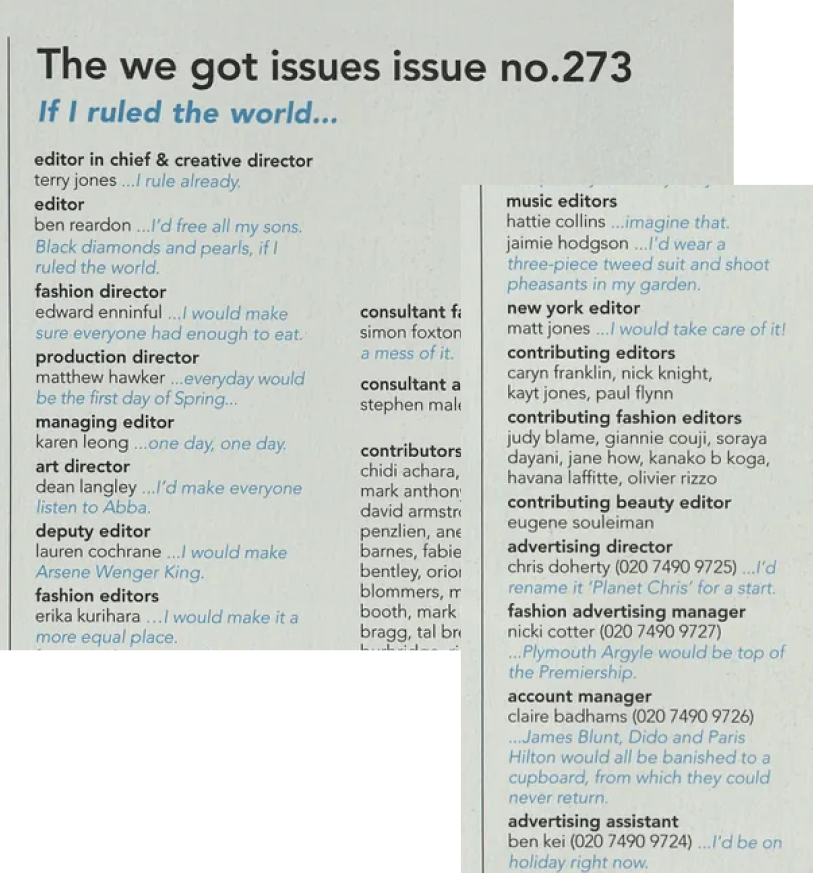
For issue no. In February 2007, the magazine posed the question “If I ruled the world…” to the editorial team, including the advertising assistant and account manager. Fashion director Edward Enninful wrote: “I would make sure everyone had enough to eat.” Fashion editor Francesca Burns wished “high heels would be mandatory,” while the accountant Colette Kinsella penned “a normal working life would be three days a week, if you work part-time you work one day.”
4. All those Kate Moss images came from somewhere!
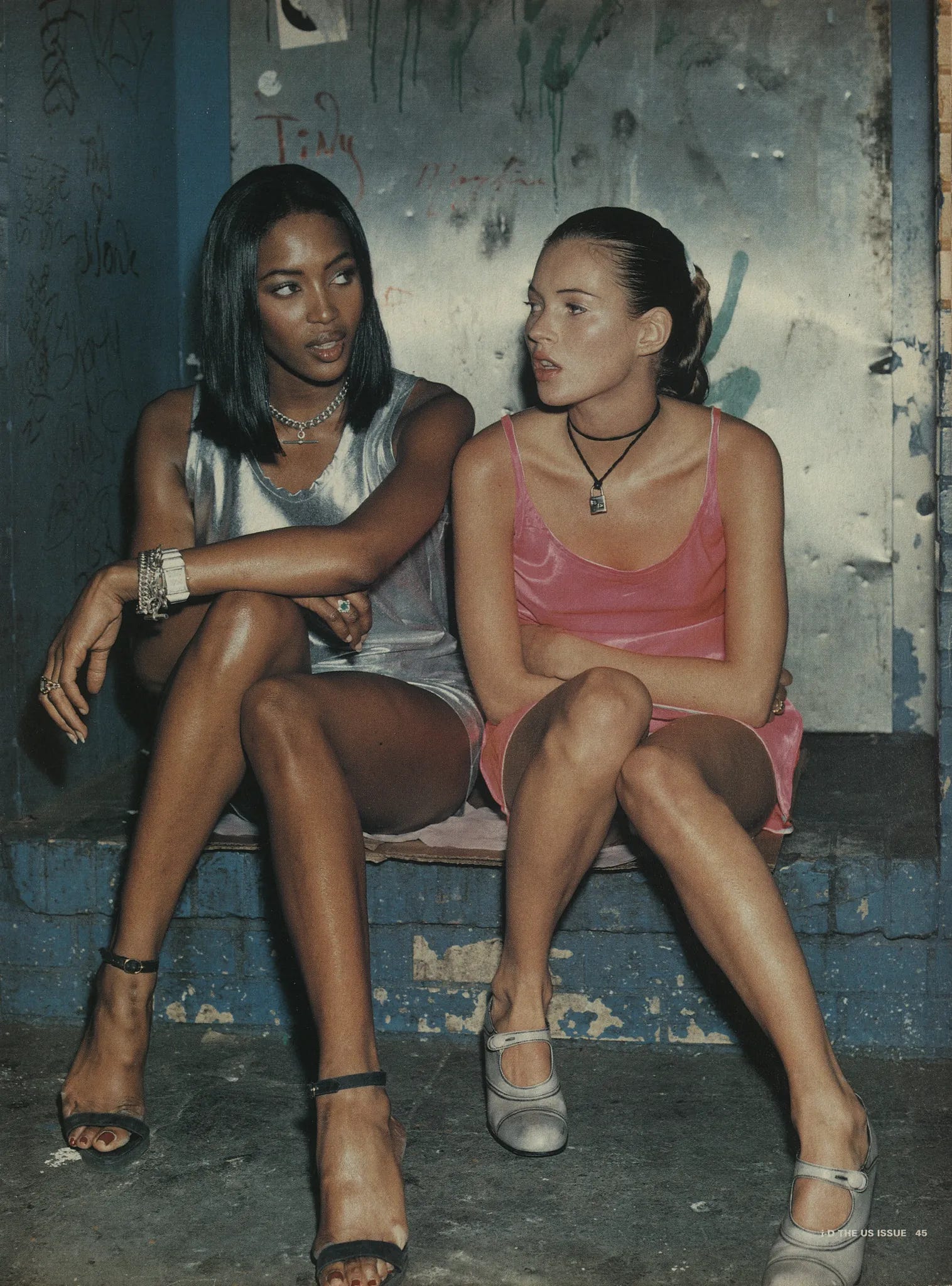
When I talk about images marooned on social sites, many of these are Moss’s i-D images. The model went on to appear on the cover of the magazine 20 times. This was her first one at the ripe age of 18 in December 1993, where she posed in a baggy sweater in a spread photographed by the woman who discovered her, Corinne Day. One image I had seen vomited again and again on the internet is from the cover with Naomi Campbell and Kate Moss strolling out of (or into) the nightlife abyss from August 1994. Inside, to introduce a story on New York, is a photo I have seen the most of. It shows the supermodel duo perched on a stoop: Moss in a slinky pink slip and Campbell in a tunic dress. This was created by the team of greats: photographed by Steven Klein and makeup by Pat McGrath!
5. The i-D merch was slammin’
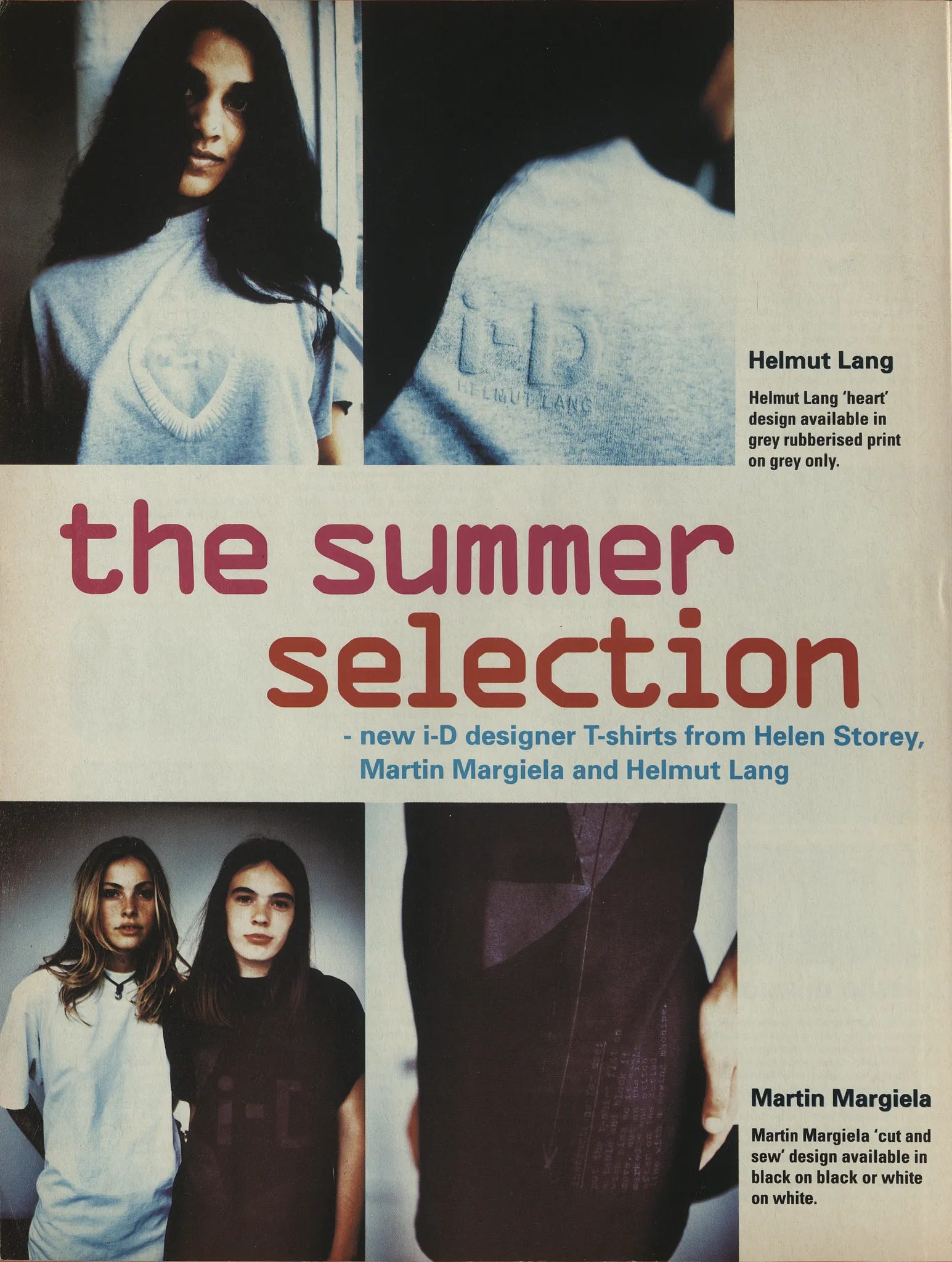
There was once a time when the world was teaming with i-D merch. Collaborations from Simon Foxton, a young Judy Blame, and a freaky deaky Shawn Stussy. If anyone can find i-D merch, please tell me. No offense to the team (although they admitted it themselves), but i-D is the most difficult, worst word to search for on resale sites.
6. People
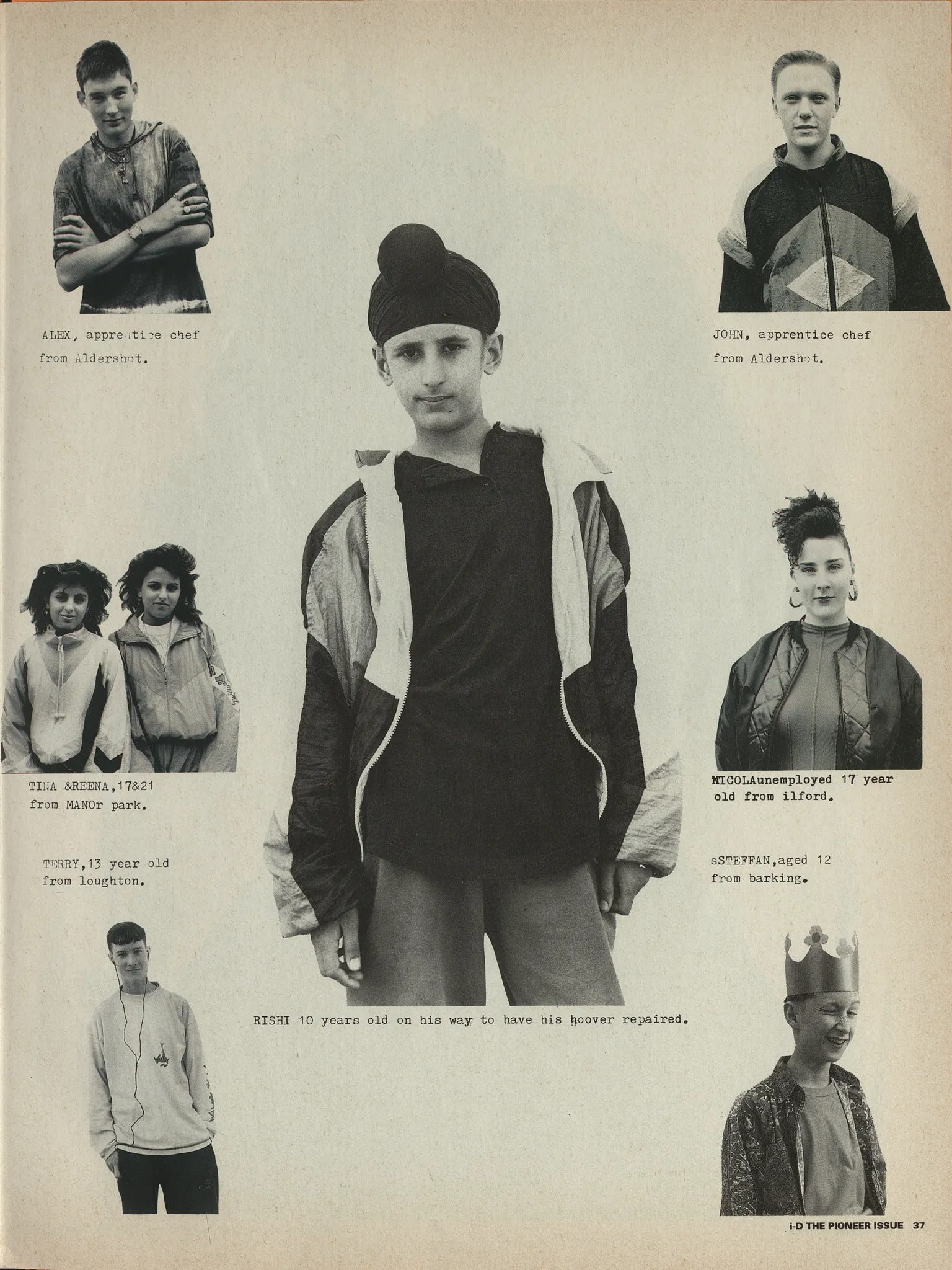
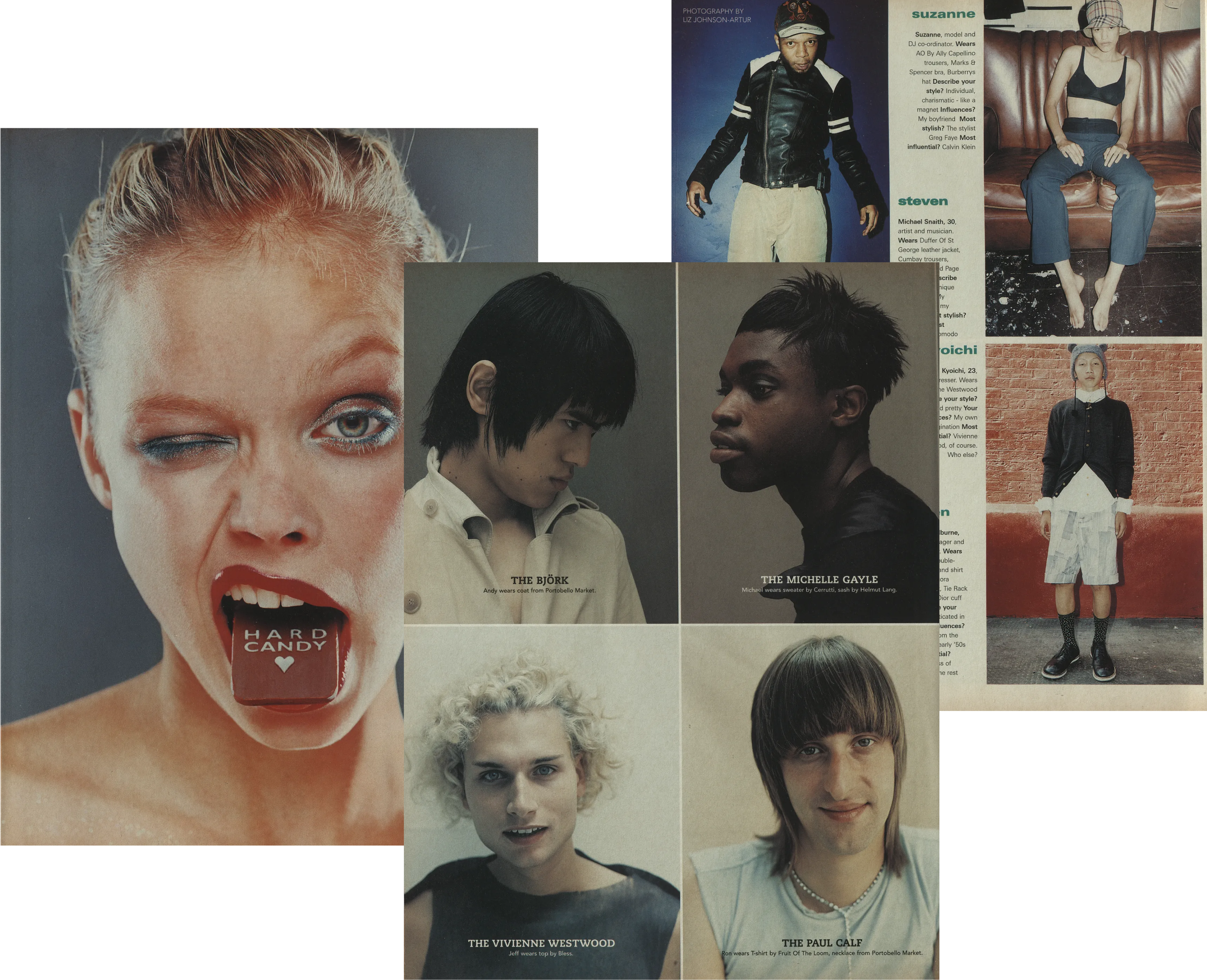
i-D did an incredible job of chronicling everyday people. There is a curiosity here that captures subjects in their most honestly dressed moments—similar to how Biz Sherbert chronicles youth in American Style. From the November 1997 issue says it best about the magazine’s role in interviewing and photographing people in their clothes: “The intention was to find fashion at its source, giving credit to new ideas born on the streets.”
One of my favorite spreads is from the January 1991 issue titled “Teenage Precinct Shoppers.” (The credits read as “With Help from Melanie Ward.”) The opening paragraph talks about the “small percentage” of elites who shop at Alaïa and Bodymap, but that a majority of the country heads to Marks & Spencer. The page shows a handful of kids in their favorite garms. Diverse. Vibrant. It’s a historical time capsule with subjects in their windbreakers, a 10-year-old boy named Rashi in a dastar en route to get his “hoover repaired”, a smiling lad in a Burger King crown, and a 17-year-old unemployed girl from Ilford in a bomber jacket and hoops.
7. Creative Freedom!
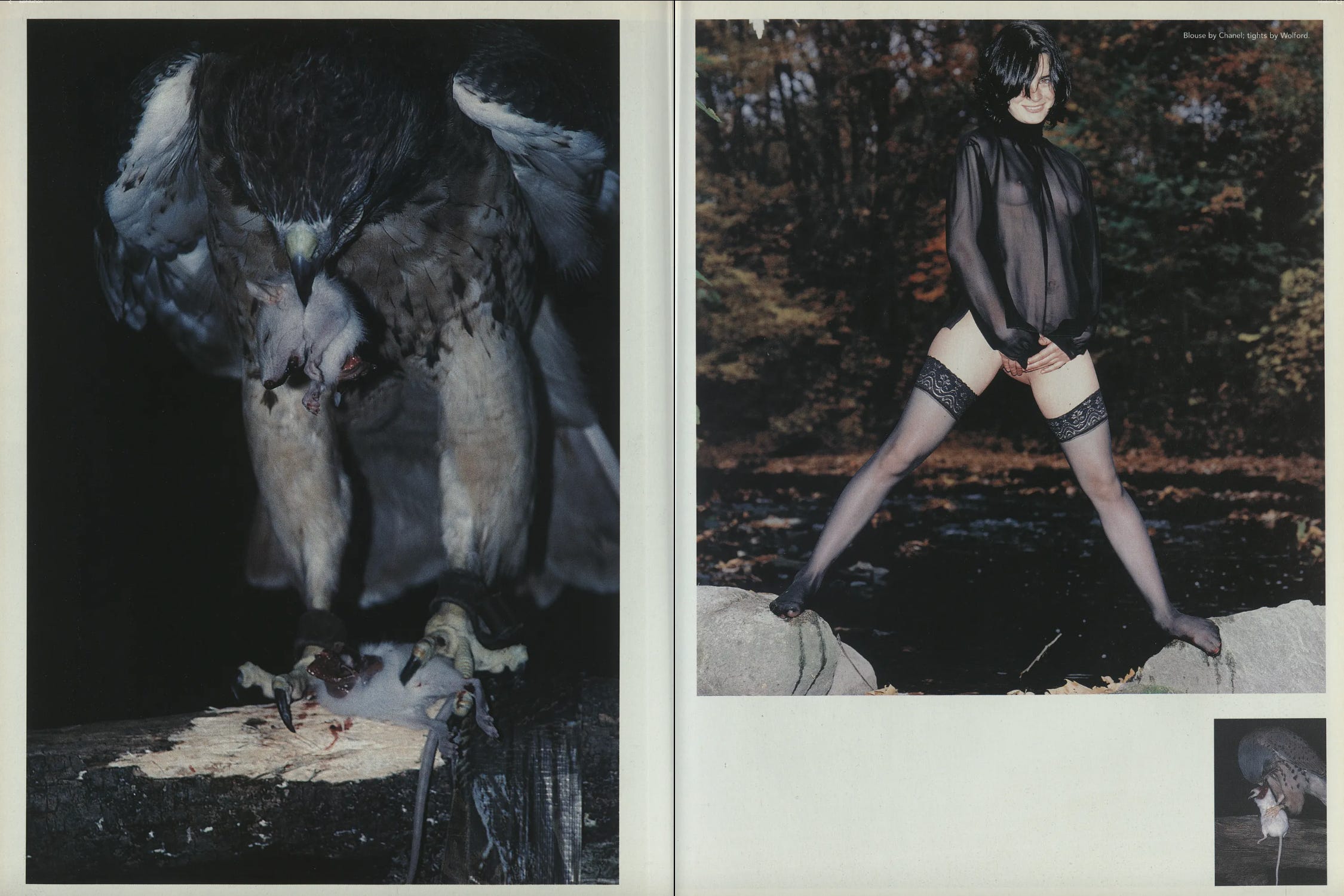
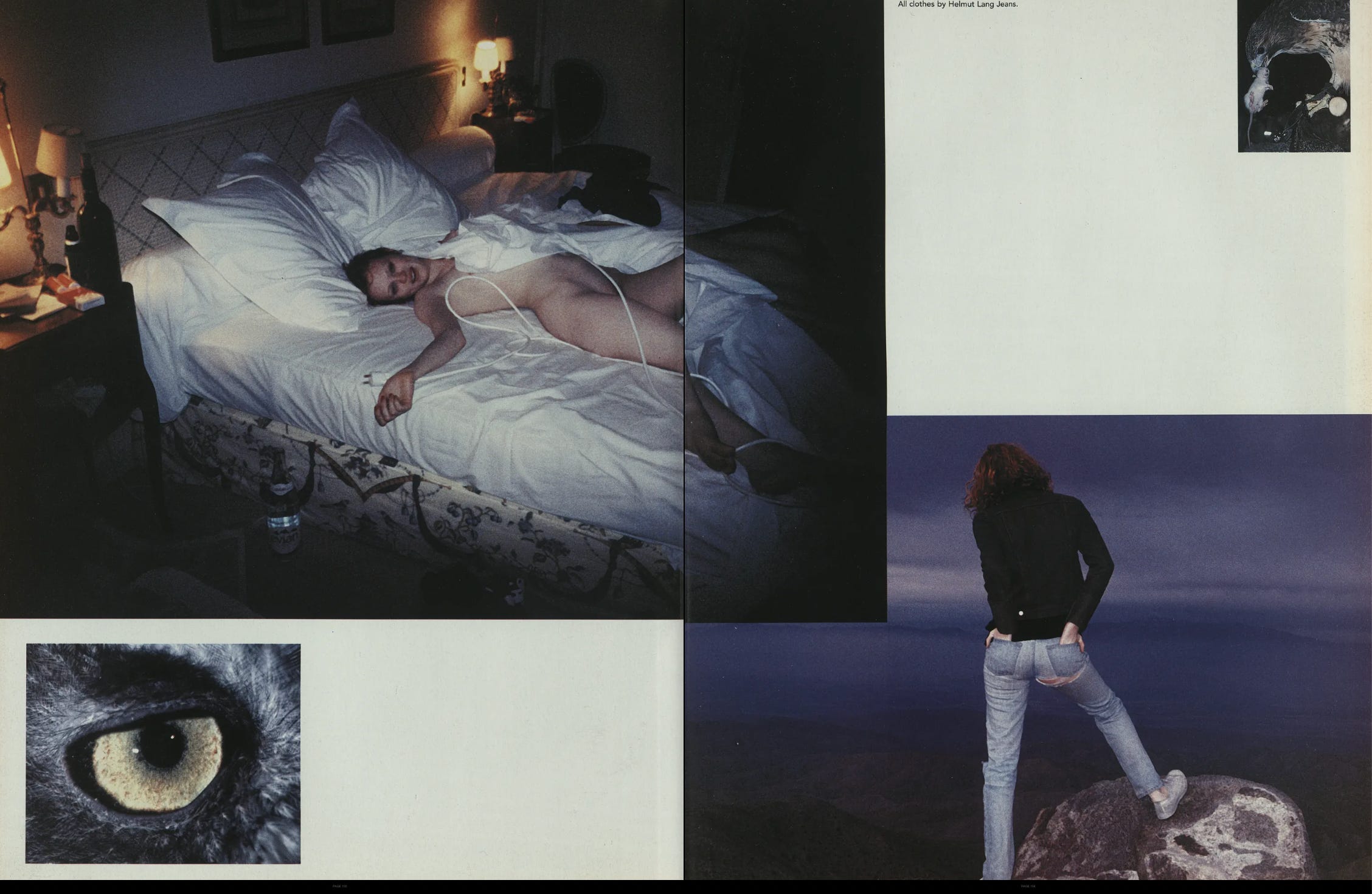
We see that unhinged zine mentality of i-D all the way through the magazine. The graffiti. The design. The advertisements. The photography is sometimes raucously bizarre. Photographer Alexei Hay had a wild (quite literally) editorial titled “The Raptor Project” in the February 2001 issue that featured a model collaged with photographs of wild birds and owl eyes. One image shows a hawk tearing the head off of a mouse.
Here is a short interview with Hay about the shoot.
LS: How did the shoot come about?
All those pictures were done with bags of clothes that were lent to me without stylist, which was a crazy thing. I know we got those clothes from Chanel, and the stylist was supposed to do that job, but he didn’t know how to call the showroom. He hadn’t done the job yet. So I think I called or he called or maybe he got them. I don’t know, but I had the bag of clothes in a sports sack bag.
LS: Why did you include the animal photography in the raptor shot?
Hay: It was a weird science photography challenge. You could shoot a supermodel and animals.
i-D was a place where you could draw from anything: you could do science photography, you could mix it with fashion, you could mix it with intimate sort of friend pictures, and they would even let me incorporate a picture that I took in college because it just went with the themes. And that was unheard of in an editorial thing, in an editorial arena. And remember i-D was still, it was just at the point where it was becoming very commercial too. I think I turned down one story because they wouldn’t let me smoke.
i <3 the If I ruled the world section
I too was once a teenager dreaming of high fashion and saving loads of images to my computer from live journal/the fashion spot (TFS), because magazines are expensive. Now in adulthood, I still buy a couple of back issues of magazines a year at an eye watering 30-40 a pop...If I understood correctly, i-D's archive will be available online? If so, this is fabulous news. I for one cannot afford the $200 copy of Devon Aoki with a leaf over her eye but I would LOVE to see the rest of the editorial