


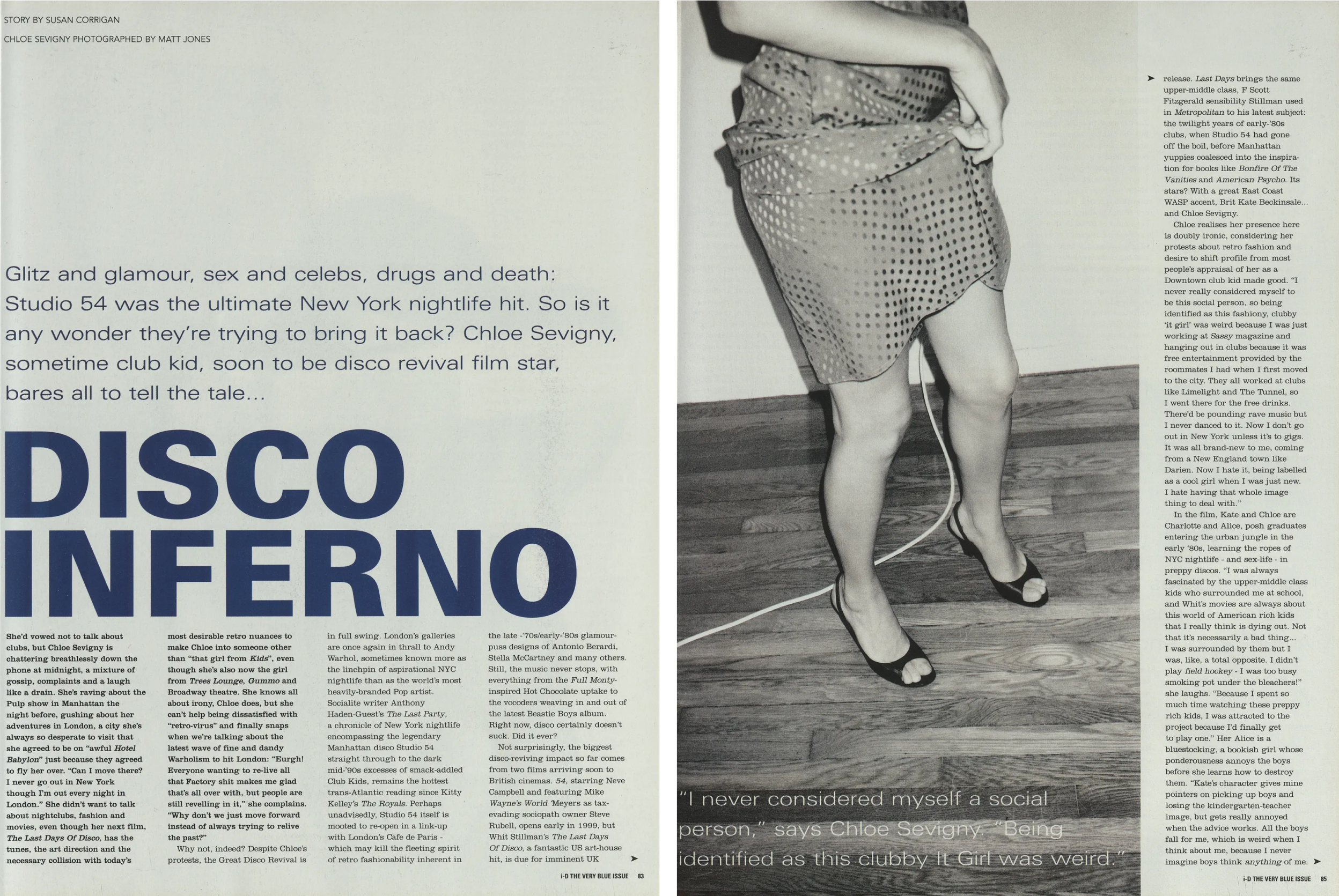
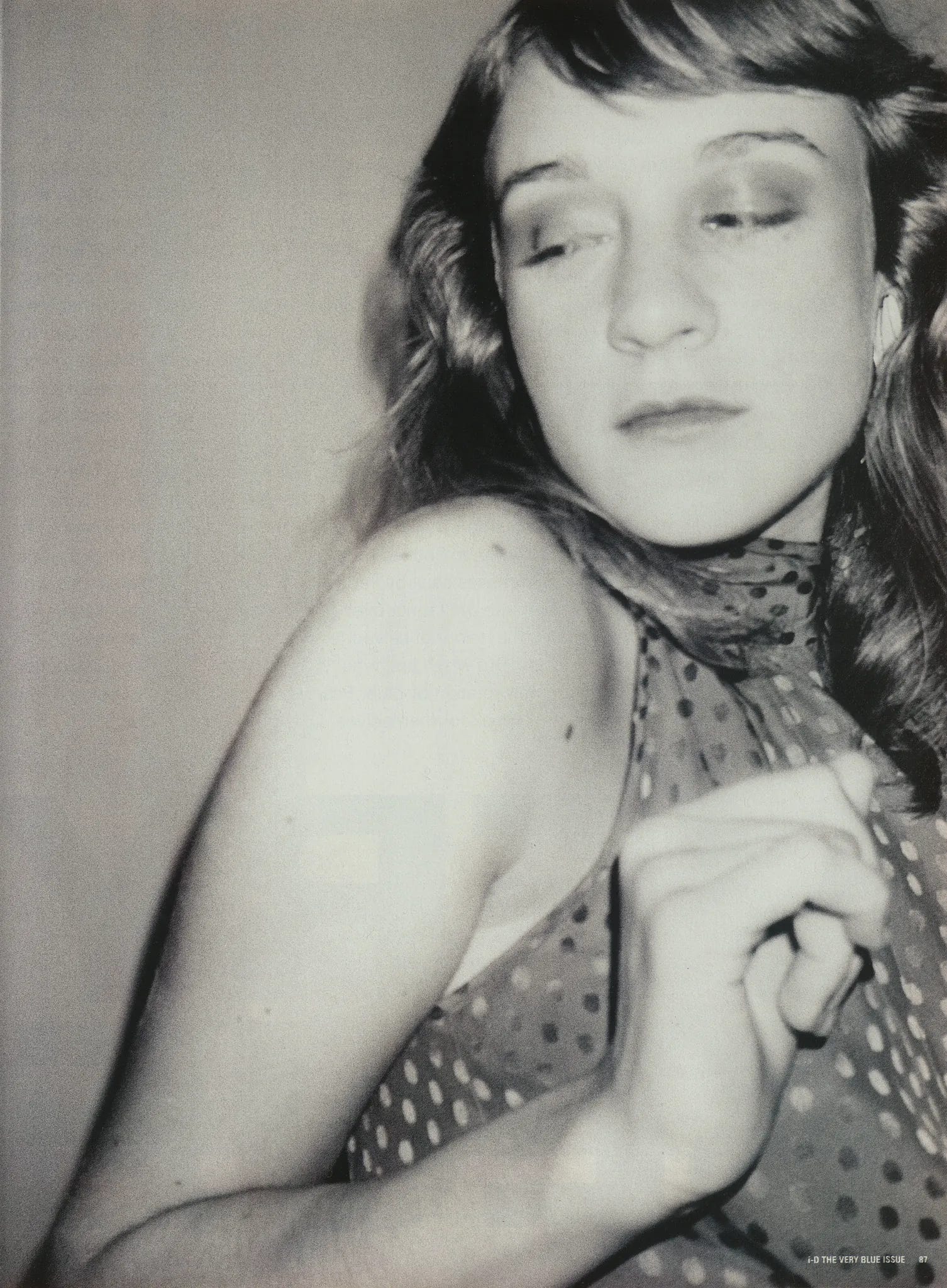
Back in 1998, the nightlife scene was in shambles. Drugs were becoming more mainstream than ever and nostalgia for the dancing days of disco—Studio 54, at al.—were at a fever pitch. Sorta similar to now, in that everyone is on designer drugs and fantasizing about Limelight. Chloë Sevigny stopped by i-D while promoting The Last Days of Disco in 1998 to talk about going out, being an it girl, and club philosophy. We’re reprinting her interview with Susan Corrigan, from i-D 178 “The Very Blue Issue” here.
.

She’d vowed not to talk about clubs, but Chloë Sevigny is chattering breathlessly down the phone at midnight, a mixture of gossip, complaints and a laugh like a drain. She’s raving about the Pulp show in Manhattan the night before, gushing about her adventures in London, a city she’s always so desperate to visit that she agreed to be on “awful Hotel Babylon” just because they agreed to fly her over. “Can I move there?”
“I never go out in New York though I’m out every night in London.” She didn’t want to talk about nightclubs, fashion and movies, even though her next film, The Last Days Of Disco, has the tunes, the art direction and the necessary collision with today’s most desirable retro nuances to make Chloë into someone other than “that girl from Kids,” even though she’s also now the girl from Trees Lounge, Gummo, and Broadway theatre. She knows all about irony, Chloë does, but she can’t help being dissatisfied with “retro-virus” and finally snaps when we’re talking about the latest wave of fine and dandy Warholism to hit London: “Eurgh! Everyone wanting to re-live all that Factory shit makes me glad that’s all over with, but people are still reveling in it,” she complains.
“Why don’t we just move forward instead of always trying to relive the past?”
Why not, indeed? Despite Chloë’s protests, the Great Disco Revival is in full swing. London’s galleries are once again in thrall to Andy Warhol, sometimes known more as the linchpin of aspirational NYC nightlife than as the world’s most heavily-branded Pop artist.
Socialite writer Anthony Haden-Guest’s The Last Party, a chronicle of New York nightlife encompassing the legendary Manhattan disco Studio 54 straight through to the dark mid-’90s excesses of smack-addled Club Kids, remains the hottest trans-Atlantic reading since Kitty Kelley’s The Royals. Perhaps unadvisedly, Studio 54 itself is mooted to re-open in a link-up with London’s Cafe de Paris—which may kill the fleeting spirit of retro fashionability inherent in the late -’70s/early-’80s glamour-puss designs of Antonio Berardi, Stella McCartney, and many others.
Still, the music never stops, with everything from the Full Monty-inspired Hot Chocolate uptake to the vocoders weaving in and out of the latest Beastie Boys album.
Right now, disco certainly doesn’t suck. Did it ever?
Not surprisingly, the biggest disco-reviving impact so far comes from two films arriving soon to British cinemas. 54, starring Neve Campbell and featuring Mike Wayne’s World Meyers as tax-evading sociopath owner Steve Rubell, opens early in 1999, but Whit Stillman’s The Last Days Of Disco, a fantastic US art-house hit, is due for imminent UK release.
Last Days brings the same upper-middle class, F. Scott
Fitzgerald sensibility Stillman used in Metropolitan to his latest subject: the twilight years of early-’80s clubs, when Studio 54 had gone off the boil, before Manhattan yuppies coalesced into the inspiration for books like Bonfire Of The Vanities and American Psycho. Its stars? With a great East Coast WASP accent, Brit Kate Beckinsale... and Chloë Sevigny.
Chloë realizes her presence here is doubly ironic, considering her protests about retro fashion and desire to shift profile from most people’s appraisal of her as a Downtown club kid made good. “I never really considered myself to be this social person, so being identified as this fashiony, clubby it girl was weird because I was just working at Sassy magazine and hanging out in clubs because it was free entertainment provided by the roommates I had when I first moved to the city. They all worked at clubs like Limelight and The Tunnel, so I went there for the free drinks. There’d be pounding rave music but I never danced to it. Now I don’t go out in New York unless it’s to gigs. It was all brand-new to me, coming from a New England town like Darien. Now I hate it, being labelled as a cool girl when I was just new. I hate having that whole image thing to deal with.”
In the film, Kate and Chloë are Charlotte and Alice, posh graduates entering the urban jungle in the early ’80s, learning the ropes of NYC nightlife—and sex-life—in preppy discos. “I was always fascinated by the upper-middle class kids who surrounded me at school, and Whit’s movies are always about this world of American rich kids that I really think is dying out. Not that it’s necessarily a bad thing… I was surrounded by them but I was, like, a total opposite. I didn’t play field hockey—I was too busy smoking pot under the bleachers!” she laughs.
“Because I spent so much time watching these preppy rich kids, I was attracted to the project because I’d finally get to play one.” Her Alice is a bluestocking, a bookish girl whose ponderousness annoys the boys before she learns how to destroy them. “Kate’s character gives mine pointers on picking up boys and losing the kindergarten-teacher image, but gets really annoyed when the advice works. All the boys fall for me, which is weird when I think about me, because I never imagine boys think anything of me. All the boys probably think I’m a junkie anyway.”
“The Last Days Of Disco is the anti-disco movie,” explains director Whit Stillman. “We didn’t want to be Saturday Night Fever or 54. None of my films are precisely about nightlife, though they take place in nightlife settings with music and dancing. It’s very different from the broad strokes of mid-’70s imagery that most people associate with disco. One of the reasons I wanted to do it is because I think the ending of a scene is more interesting and poignant than its beginnings.”

Whit Stillman was first bitten by the discotheque bug in London on a teenage visit to Annabel’s. It was 1976 and punk was in the ascendant. “For me, punk was the thing threatening disco. I just didn’t like hard rock, so the whole ‘Disco Sucks’ attitude of American and British punks seemed like the attitude of sour losers. People who couldn’t dance and were clueless and aggressive about it. Maybe they’re the same people who now live in a world of pop culture clichés and have vengefully turned on us for not presenting them with the pabulum, hackneyed views of disco that they’ve come to love.”
Strangely enough, Stillman’s film manages to take the pulse of current fashion—where the early-’80s lines he uses and enthuses about are being duplicated all over again in fashion and beauty pages. “I think it’s very bad when you go to a movie and you spend the whole time thinking how weird people’s clothes were back then,” he rues.
“So we tried to use a look that was less ‘period’ to us now so we could cheat the retro virus. It was a trim look which was an homage to how things actually looked in 1962, when I was ten, which is the last time I can remember looking at the world and thinking that everything was wonderful. And in 1982, when I was wearing the look I put in our movie, my wife was impressed with me because she thought I looked New Wave. In fact, I was just a preppy without a suntan.”
Obviously, the sun never shone in Stillman’s old haunts. Darker still is The Last Party, Anthony Haden-Guest’s chronicling of 20 years of Manhattan nightclubbing intrigue. Having served as a consultant to Stillman, Haden-Guest’s input laces Last Days with a noir sensibility, but the blackest tales possible are the main feature of this compulsively gossipy, decadent book. Comprehensive documentation of the drugs, funny money and Mafia presence fuelling New York nightlife through the ages, it’s a far cry from the shiny, happy experience most of Britain’s five million clubbers go in search of every single weekend. Where big bucks and big clubs were the product of big egos, tragedy loomed. Haden-Guest calls it Nightworld and it’s an alluring place, though not always an attractive one. “I liked the book,” enthuses Whit Stillman. “But it’s a really different view of things from mine, because it’s the most sordid, rich, anecdotal version of it all, told from an insider ‘VIP High Command’ point of view. He likes to go for juicier meat than we did in our film, and invents all these interesting tags to describe the people involved as if they were components in a tossed salad. He calls our preppy clubbers the Baby Lettuce group because their views of nightlife were so innocent and romantic. It shows us how clueless most people are about what goes on behind those velvet ropes.”
Haden-Guest’s take on disco is the smooth, sinuous world of nightclub-bing, a far cry from London retro superclubs like Carwash and Starsky & Hutch, and the velvet ropes Stillman describes were instruments of exclusivity designed to keep the out-of-town and out of sync at bay. Significantly, the book marks the beginning of the era where Nightworld figures became much more than venue organisers and party-givers. Instead, nightlife figures became the first “social curators,” creating a living gallery/museum of aesthetics based on the elevation of glamour, cool and the shock of the new. To be successful, clubs like Studio 54 had to shock over and over to maintain their operators’ cultural influence and prove the kind of nous that had figures like Andy Warhol—a prime social chameleon and magpie—coming back for more along with a throng of fashionable folks keen to be part of the action. Haden-Guest’s book also charts the rise and fall of Nightworld fortunes with the cold logic of the Law Of Averages. For every Steve Rubell, peaking early before tax evasion jailed him and AIDS killed him in 1989, there’s someone like his ex-partner lan Schrager, who survived the albatross of Studio 54 ownership to amass a fortune as the hotelier behind cutting edge palaces like The Royalton, midtown Manhattan favourite of the fashion police.
Since the ’60s, when Warhol (him again) coined the term, every “superstar” who found themselves blossom and grow in clubland and then beyond is matched in equal numbers by countless individuals who’ve died on the vine. It never changes: for successful ex-club kids like Madonna, Harmony Korine, and Chloë Sevigny, there’s casualties such as Michael Alig, suspected of killing fellow Club Kid Angel Melendez in a case that’s stonewalled clubland impresario Peter Gatien of Limelight and Tunnel, the man who introduced the shocking Leigh Bowery-esque Club Kids, fashion victims and promoters, to his Downtown clubs.
The Melendez murder case—like the 1986 ‘preppy murder’ of Jennifer Levin, an underage clubber—shut down Nightworld at the behest of New York mayor Rudolf Giuliani, causing the clubbing vibe to go darker, smaller, more underground as a result. Yet the myths are still intoxicating, no matter the number of shootings... or incidents of shooting up.
Could we be headed for the same thing here? After the mid-’90s boom, British culture may be heading for its Cruel Britannia phase, when New Labour’s puritanism will clash with a liberalised public reared on rave culture and very different ideas of personal responsibility than those espoused by their elected leaders. Handbag house and the lager-thump of Big Beat have given way to noirish dancefloor stylings in smaller clubs, fashions are more predatory, drugs harder and more severe. This is hardcore, and London’s becoming a Dante’s Inferno of materialism and bloody-mindedness after our half-decade of Ecstasy daze; there’s a renewed interest in exclusivity and cool.
People now exchange the purity of inspiration—what originally got us searching mean streets for action—for cheap lays and tactics which would be shocking were they not so retro and reactive. Cocaine is now the mass drug of choice, not just an aspirational little something for the weekend used by media types to go mega-meta. Crack is being used by folks outside the Brixton/Hackney front lines, and that’s big news. And heroin? Not so much chic as going mainstream, it’s increasingly the drug of choice for suburban wannabes who’ve given up on going out—a sign that some young people are too scared and self-obsessed to go anywhere at all.
However, some solace is available if the present state of clubbing and fashion presents a bigger downer to pop-culture junkies than a Studio 54 Quaalude. The metallic blade of Nightworld is like a circular saw: it slices through today’s scene, recycling, changing the vista, knocking down icons and institutions to clear the way for something new. Cutting edge doesn’t even begin to describe it. Bombast about drugs is only a kind of warning the actual chemicals never go out of use or totally out of fashion.
And people will always go to clubs because, even at their darkest, we go because clubs are a portal into a world of fantasy and make-believe; we try on masks and assume roles in clubland, after dark. Before the boom goes kaboom, it’s crucial to realise there’s more to today’s nightclubbing revival than new twists on old hemlines, glitter eye shadow and fake drug-fuelled escapism. Admittedly, most of us aren’t the privileged few on the guest lists of small, exclusive places, but millions still go clubbing to look for something better, more glittery and more glamorous than the lives we’ve got. And for a select group—Chloë Sevigny, for one—clubs are an identikit, the dancefloor a zone where people work out the process of becoming real individuals, unhindered by the trappings of their former status-quo lives. Even if, like Chloë, you weren’t even dancing at the time.
Written by Susan Corrigan
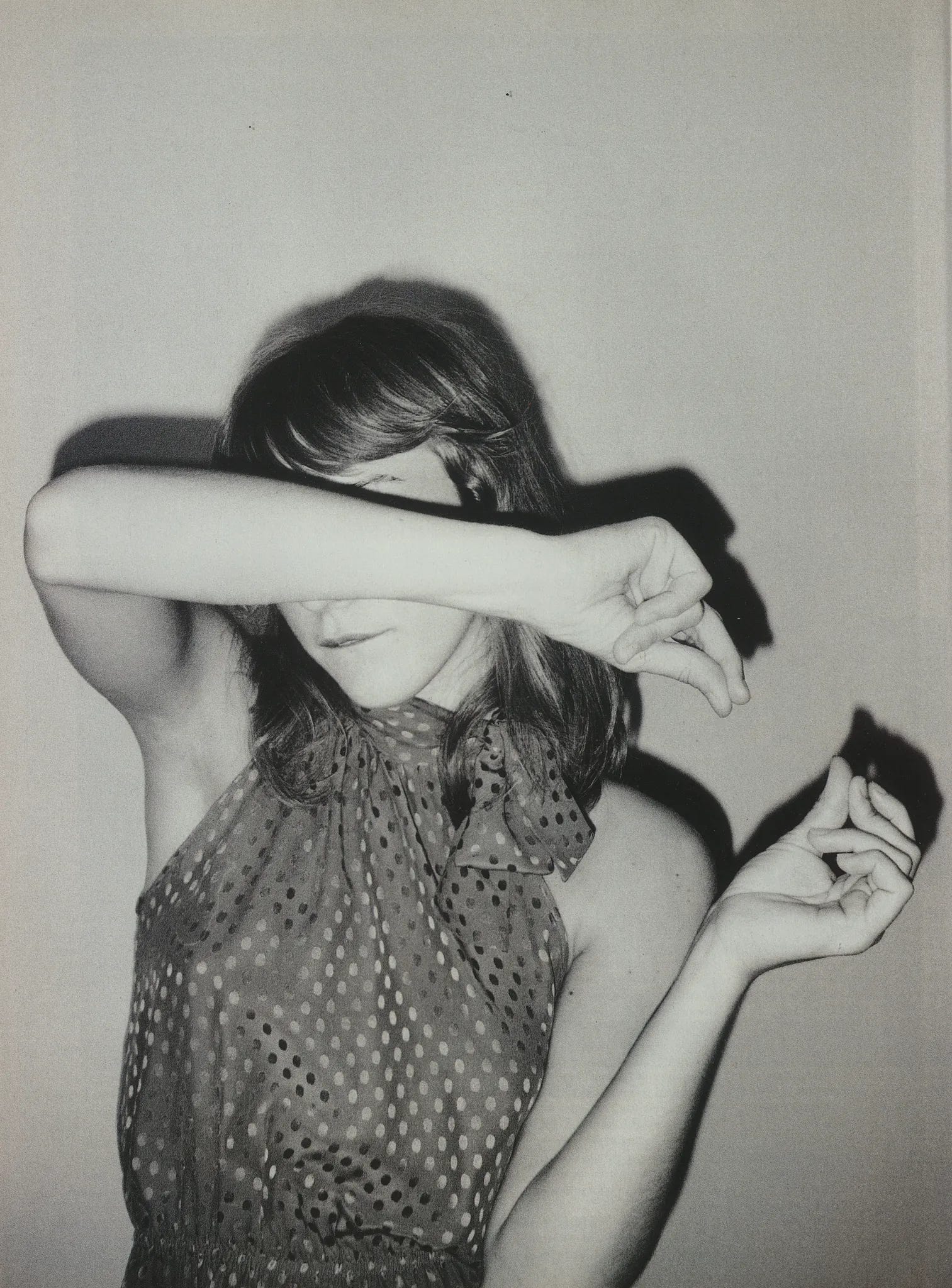
Chloë Sevigny photographed by Matt Jones
My favorite, always
Brilliant. 🤝🦈🥇