


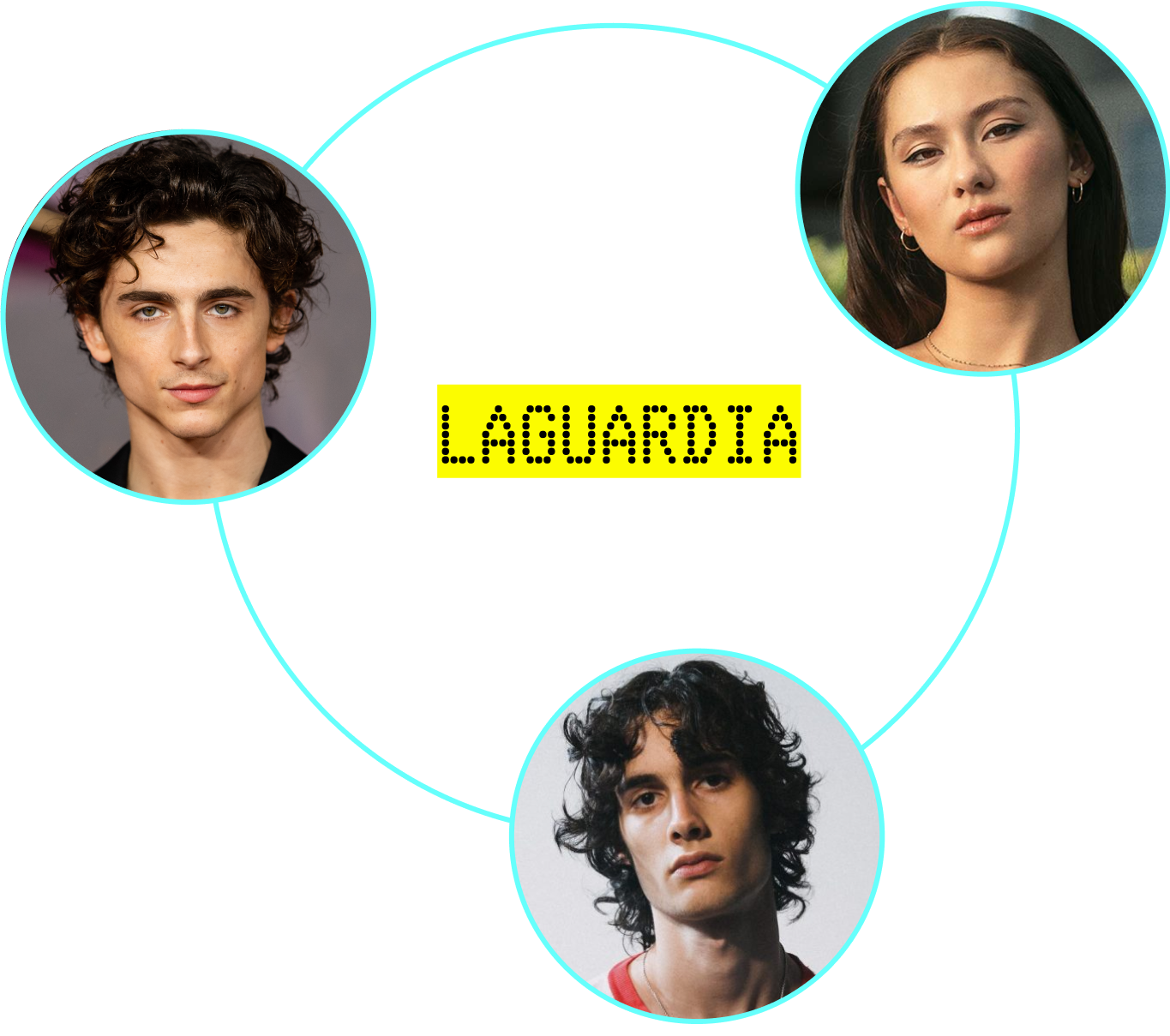
Up on 65th Street, in Manhattan, there is a two-block enclave that’s defined stardom (at least in New York) for the past hundred years. Walking around, you’ll find a stream of students carrying cellos on their back and dancers with shoes tucked into their backpacks all headed to one of three cultural institutions: the Metropolitan Opera House, Juilliard, or LaGuardia High School.
Between the ages of 14 and 17, at a moment when the adolescent brain is as malleable and pungent as a cantaloupe left out on a summer’s day, I attended LaGuardia, the prestigious New York City public school, where I majored in music. Each day upon entering the school, I passed by a wall with tiny alumni pictures on it: Liza Minelli, Nicki Minaj, Azealia Banks, Jennifer Aniston, Al Pacino, Sarah Michelle Gellar. Jazz musicians, composers, opera singers, the heavy hitters keep coming. Because of this, I’ve seen everything Timothée Chalamet has ever been in. Including this (my best friend was waiting in the wings to go on and almost died slipping on one his dancers’ wigs). I’m not Jr. Club Chalamet, I just went to school with the guy!

Having spent my formative years in this incubator of creativity, I feel uniquely equipped to answer a question that’s been burbling up in mainstream culture:

The opportunity for stardom is everywhere. Our coolest popstar Addison Rae was a TikTok dancer. In an Elle cover story she told Suzy Exposito, “I always knew I wanted to be famous, to be a movie star, to be a singer—to just be a performer.” Adam Friedland, sure to be the next John Stewart, is a former edgelord podcaster. Saturday Night Live is filled with internet comedians. This very magazine held an open call led by casting director (and recent Oscar nominee) Jen Vendetti to cast the first issue of revamped magazine. (Enza, our covergirl, has gone on to become an international model.) It feels like everyone is either trying to be a star or trying to find a star.
The great democratisation of the internet has flattened the world to the point where any of us, at any moment, feel capable of ascending to stardom. We are all one good post away from greatness, from an audience, from a brand deal, from our dream. Scroll through Tiktok—the entertainment app where 63% of Americans under 30 are active—and it feels like a casting call for a role that hasn’t been written. Everywhere people are showing off their talents. Need someone to do a Benson Boone impression? Looking for a musician who plays the Theremin? The question is: who is everyone performing for?
Dylan Shanks is the founder of Open Door, a music management firm that represents artists like Omar Apollo, Teo Halm, and 54 Ultra. When Shanks is scouting he’s looking for a mix of qualities: the right look, the right sound, the right vibe. He tends to go to a show at least once a week. “But Tiktok is the most important place on the internet. That’s how the majority of artists and songs are found these days. If something goes viral, it’s not that it makes me more interested, it just means that there’s a much higher chance I actually discover it and if I’m discovering it then that means it’s probably resonating with people.”
During the pandemic the internet was filled with viral musicians. Record labels hoping to capitalize on the virality would swoop in and offer musicians record labels. A lot of those artists (who made the charts) don’t have careers anymore. In some cases early exposure can be a good thing Shanks points out. Addison Rae has a built-in audience long before “Diet Pepsi.” “It seems like it bought her the space to make her music without as much interference from a record label,” Shanks says “A lot of artists, on a first album, don’t always get the opportunity to do that. And that lack of interference and trust led to it being an extremely cohesive album.”
He reminisces about first meeting Omar Apollo, “He played at an Art Gallery in Chicago with a bunch of artists. He sounded great, but what really caught my attention was that later he was dancing, the center of attention without even really trying, and I remember seeing and being like, Oh, he just lives for that. That’s a person who wants to be on stage and perform.”
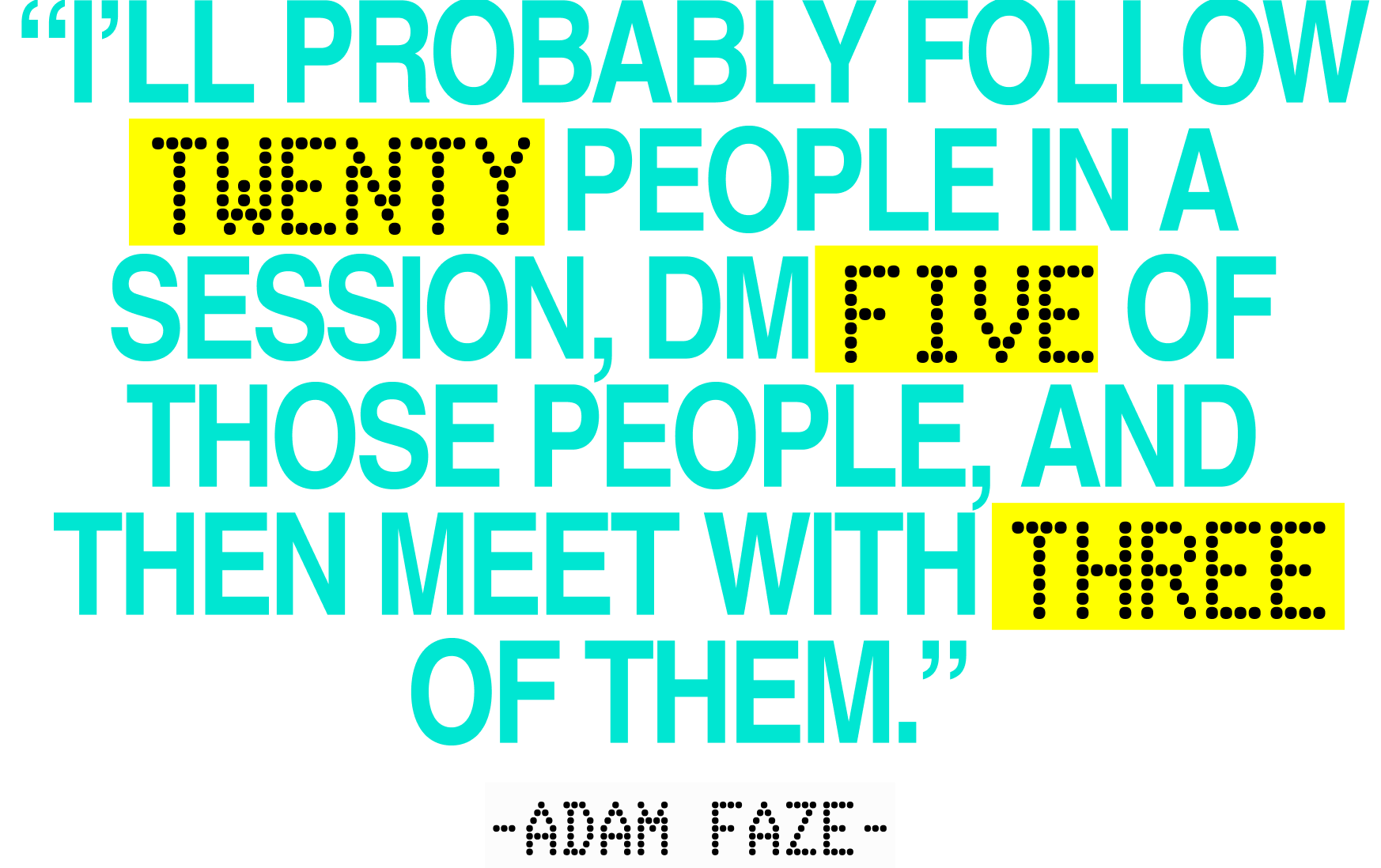
Adam Faze, Tiktok producer extraordinaire, has similarly been on the frontlines of the shifting landscape of entertainment for his entire career. We’ve known each other for years (I think I was one of the first people to profile him) and in that time, one thing has remained consistent: any interesting new person emerges online and Adam is already following them. “When I’m on Instagram Reels I’ll probably follow 20 people in a session, DM five of those people, and then meet with three of them.” Faze was bullish on megastar Kareem Rahm–their show Keep the Meter Running predated Subway Takes and is a personal and wonderful watch, somewhere between Parts Unknown and Comedians in Cars Drinking Coffee. Beyond having a steady eye on a moving target, Faze is also producing stuff that’s just, well, objectively good.
Despite the volume of people he seems to be DMing, Faze’s thoughts about stardom are pretty conservative, “Even though we’re in a time where we’ve never had more creators, more people making content, more people trying to become famous…I think we still have the same number of stars. Star power is star power, it’s not something that can be created, it’s not something that can be taught.” Faze chalks it up to something essential, bordering on mystical, “Look at Kareem, he’s the only short form host that exists who truly feels larger than life. It didn’t matter then when we started Keep The Meter Running he didn’t have that big a platform, in my head he was already the most famous person.” He gives me another example: teenage streamer iShowSpeed, “Speed would’ve been famous in any generation, Kareem would’ve been famous in any generation. It shouldn’t be so tied to the moment. In some way it’s just destiny. You can create myth and lore. I think the people that are the best at that is Hybe [the creators of Katseye]. But it’s a very different type of star power. You can only go so far when the whole thing is manufactured.”
With the way media works the business behind stardom is more important to a musician’s career than ever. Shanks makes the point that once you’ve gotten somewhere it’s even harder to stay afloat, “Music isn’t the only thing an artist has to worry about now. Now you have to run a TikTok page, an Instagram page, a burner Instagram page, a Twitter, a Discord, interviews, plus come up with ideas for videos and artwork and marketing.”
Faze’s take is basically entertainment gatekeepers need to get a grip. They know how to spot a star, they’ve been doing it for years, “It feels like something shifted in the past 15 years because of the internet. The entire industry of Hollywood, not understanding why certain people have platforms and instead of developing talent the way they’ve done for a hundred of years, are instead like ‘We don’t get it but the kids like this person and they have 100,000 followers so might as well build something around them.’ Same with the music industry, they find these kids with a viral video, sign them, give them a lot of money but they don’t have staying power, and it’s like yeah… You’re hiring the digital equivalent of a one hit wonder.” Since Faze’s whole career has been in this new frontier of digital talent and entertainment, he explains, he’s managed to escape the pressure of working with people simply because the numbers are in their favor.
Finding that perfect rising star is a balancing act that casting director Stella Tompkins spends most of her time doing. Tompkins, who scouts talent for both herself and Kate Antognini, relies on a mixture of street scouting and internet casting. “The internet has given so much accessibility. So much of my days are spent scrolling through Instagram looking for talent. It’s annoying because post COVID it’s all self-tapes versus in person casting. It’s hard to judge someone from a tape that they could redo over and over. To break the online cycle of what the algorithm is feeding me I feel like in person casting is needed.”
Even for those attempting to ignore the internet and hold on to the old method of stardom, COVID ushered in an inescapable technological turning point. Few auditions are held IRL anymore. Not even those of my alma mater! During COVID LaGuardia switched over to virtual auditions, with an in-person call back. (Much less terrifying than the nerve-shattering audition process I experienced where you’re made to perform live in front of a small consortium of teachers.) Despite the change in medium, they’ve been steadily producing stars, everyone from Sombr to Lola Tung of The Summer I Turned Pretty. I wondered if what they were looking for remained the same.
I reached out to my High School music teacher Mrs. Ballard. Ballard has been teaching at LaGuardia for the past 19 years and beyond being a truly wonderful educator is also an authority on the subject, her past students (to name a few: Theo Hoffman, Aryeh Nussbaum Cohen, Sofia Hunt, Meryl Dominguez) have gone on to sing globally. How do you listen to a thirteen year old and see what they can become? Ballard describes a focused approach, “I’m looking for preparation. Do they understand what they’re singing about? Are they being expressive on a different level? We’re looking at young singers, we’re looking for raw ability, that beautiful voice or ear. That’s the thing that’s most captivating.”
In this wild west of the attention economy, it can feel like there’s this mad dash to find the next big star, leading to young people feeling embittered that they’ve haven’t “made it” by a certain age, and gatekeepers confused that what they think should be working isn’t. Ultimately it’s not so black and white, and things aren’t so different. The Harrison Fords (became famous in his thirties) are just as abundant in Hollywood as the child protegees. And the real question…why does everyone want to be a star? Maybe you shouldn’t want to be? Do you want to be an artist or do you want to be famous? Do you want to be a great actor or do you want to be a celebrity? Do you want more eyes, people watching your every move, commenting on your posts? Maybe that’s the real trick the internet has played on us –convincing the general population that they want the downside of celebrity without the artistry.
I believe those who need to perform, for their soul and for the world, will eventually make it. My mom likes to tell a story about my High School audition. She was sitting in the hallway waiting for me when a girl came up to her and asked if she’d like to hear her sing. My mom said yes (obviously) and the girl unleashed a performance so beautiful, so exceptional, it was bizarre that it came out of a child. That girl was Lorna Courtney. You can see her on Broadway!

Needed this. It's always relieving to see other people's thoughts on a conversation you have in your own head everyday with no conclusion. Great article!