


Available at limited retailers in the US/UK.
written by ALEX FRANK
photography COCO CAPITÁN
styling JULIE RAGOLIA
Before such a term existed, David Byrne was the ultimate “galaxy brain” artist. As both solo act and lead singer of Talking Heads, Byrne has stitched together an impossibly wide swath of cosmic influences into a wild constellation of music and performance: a swirl of Nigerian rhythms, jagged post-punk, Kabuki-style staging, gospel, cutting edge electronica, Motown soul, and on top of it all, Byrne’s unmistakable yelp of a voice, singing—howling, often—about vicious murderers, the apocalypse, the role of technology in human life, and, on “And She Was,” a girl Byrne once knew who, as he wrote in the liner notes of 1992’s Once in a Lifetime: The Best of Talking Heads,“ used to do acid and lay down on the field by the Yoo-hoo chocolate soda factory.”

On his latest album, a deluxe edition of his 2025 record Who Is The Sky?, he has a song, “My Madness,” that itself seems to address the untamed roving of his own mind, and the peace he’s made with his most polymathic qualities: “My madness really likes me now / We’ve worked out how to get along.” This fall, Byrne, also an author, has released a new book, Sleeping Beauties: Why Good Ideas Go Dormant and How They Wake Up, which is a tribute to an array of artistic and scientific breakthroughs—“sleeping beauties”—that have faded in and out of recognition over the years. Essays about the Brazilian musician Tom Zé, the heliocentric model of the solar system, the economist Hyman Minsky, and the hybrid nature of lichens are just some of the topics Byrne covers.
Byrne first came to the world’s attention with Talking Heads, a band formed in 1975 and born out of his days as a student at Rhode Island School of Design, where he met future group members, drummer Chris Frantz and bass player Tina Weymouth. (Keyboardist and guitarist Jerry Harrison would join in 1977.) They came up in the same New York scene as Blondie and the Ramones, playing shows at the now-legendary CBGB in the grimy punk era and scoring improbable and enduring hits like “Road to Nowhere” and “Once in a Lifetime,” an earnest meditation on the passage of time and the meaning of life.
Talking Heads, who officially disbanded in 1991, always had a pop and fizz all their own—rhythmic, soulful, shaky—with a kind of 360° artistic ambition that culminated in the legendary 1984 concert film, Stop Making Sense. The movie is a carefully constructed set piece of exuberant songs and choreographed movement held together by Byrne’s unlikely, plainspoken charisma, and serrated style of dancing. Then, there’s Byrne’s fantastically oversized grey suit—reminiscent of Japanese Butoh costumes and the work of artist Joseph Beuys—that’s become so iconic it can be aped as a Halloween costume without anybody wondering what you’re going for.
Byrne continues to live and work in Manhattan, and his Union Square office is a beautiful repository of his work and interests, with big windows and a set of bright yellow shelves that hold rows of vinyl, books, trinkets, and, tucked away on the bottom level, Byrne’s Academy Award, which he won in 1988 for his work on the soundtrack to Bernardo Bertolucci’s The Last Emperor. In conversation, he is thoughtful and gentle, punctuating even some of his more serious responses with a bellowing laugh. He is also, at times, sweetly jittery, at one point absentmindedly spinning my phone—which I had on the table to record our chat—around like a dreidel. Mostly, he just seems excited: to talk about art and—ever engrossed in the here and now—to engage in the world around him.
ALEX FRANK: You’ve said that you try to avoid nostalgia. But the culture at large feels so seeped in it right now. Why do you think so?
DAVID BYRNE: Oh boy. I’ve heard of this idea called hauntology—that the ghosts of the past keep resurfacing and coming back to life. But gee—I don’t really know why. If I had to guess, I would say it’s the uncertainty of the times we live in, people’s economic uncertainty, creative uncertainty, thoughts about, Who am I? How do I fit in? Where’s the future? If they're living on their phone: What’s the real me? People might say, “Let’s live in the past when things were”—at least from a particular view—“better.”

It seems like the goal of Talking Heads was always to be as new—weird even—as possible.
Not just be weird, but that every record should be different than the one before. It’s not like, “We’re this kind of band and so that’s what we do.” You could do that for a couple of records, but then you’re almost obliged to try a new direction, which is kind of fun.
Was it surprising that music as idiosyncratic as Talking Heads could become so popular?
It was to me. We grew a following very gradually. I think Patti Smith had pretty quick success, and Blondie had pop singles almost right out of the box. We didn’t have that. We had some songs that were kind of successful, but never big pop hits in the beginning. So, it was kind of a surprise when—maybe not as much as Blondie—we started having radio hits. I thought, “Oh, this is different.” And of course your audience grows really quickly when that happens. But then you immediately realize, as I think many of these other groups and artists did as well, that it’s wonderful, but it can be a trap because now that’s what you're expected to be.
The possibility of being pigeonholed as the “‘Psycho Killer’ band.”
“Psycho Killer” or “Burning Down the House” or whatever it might be. That’s what you're expected to be from there on out. And if you deviate, you’re breaking an implicit promise. But at the same time, if you don’t deviate, if you don’t try new things, you’ll end up an oldies act in Vegas.

Is it true that touring with the Ramones early on taught you a timeless punk principle: that you don’t need to be an adept musician to make something powerful?
I don’t know if I learned it from them, but they were a good example of that. It’s deceptive because to do what they did took a certain amount of skill, but it wasn’t a traditional virtuosic skill that you would learn in music school. That was the big lesson: that you can do things yourself, and you can do it with limited means, and still convey feelings and ideas to an audience.
When did movement and dance become conscious to you?
The music we did was rhythmic, but I also was aware that there were certain kinds of movement that people before us did—rock and roll posing and James Brown—and I just thought, “I should avoid that because other people have done it.” So in the beginning I did nothing. A little twitching. Eventually, I thought, “How do I want to move?” Little by little, I would start to adopt things. I was going to a lot of downtown theater, experimental theater, not naturalistic at all. Then I started taking an interest in Asian theater, and I realized, they’re dressed in elaborate costumes and their gestures are very stylized, and that might be the way to go. Or at least that opened up a door. I realized that not only do you not have to try and move like the singers that have gone before, but you can build a repertoire that can be yours.

You write about Beauford Delaney in the book, a Harlem Renaissance painter who suffered from depression and alcoholism. A lot of artists face this. How did you avoid it?
It’s super common. We’ve seen a lot of people go from being very vibrant and creative to just being a mess. Early on with Talking Heads, I was reading these rock biographies on people like Alice Cooper, and they all had this similar arc: super successful, ego out of control, start to drink and do drugs, go into rehab, then attempt to come back. It’s a cycle. And I thought, “You don’t want to fall into that.”
I’m not 100% clean. I’ve done some drugs in the past. I still have maybe one more glass of wine that I think is sensible. But you’d see people around you who were just destroying their lives. People who’d go through a whole Jack Daniels or bottle of vodka—or two whole bottles of wine every night. And I just went, “I think I’m done.”
And I was also conscious of the whole ego thing, of thinking that it’s all about you. Because what the fans love is what you’re doing, the work that you’re doing, the songs and the performance—they don’t know you, so don’t think it’s you.
You’re not a reality TV star—you’re a musician.
This is my creativity, this is my work. This is not my personal life you’re seeing. Pretty early on, I could also see artists who surrounded themselves with security, and minders, and all these people, and I thought, “Whoa, I kind of like being able to go to the grocery store.” Being in touch with what we call real life. That’s where my inspiration comes from. If I lose that, what am I going to write about? I thought, “Okay, I’m going to make a conscious effort not to get that isolated,” even if sometimes I get pestered, which doesn’t happen that much.

There’s a story that early on Lou Reed had a talk with the band about working together. What do you remember about that?
We did go to his place after a show, and he was eating ice cream, and we were going through some of our songs and he had some creative ideas. He said, “That song would be better if you slowed it down.” He played it a little bit, and I thought, “Lou Reed’s singing my song!” He might have brought up that he would produce us, but I think we all felt like, “That’s not quite our world.”
On your 1981 album My Life in the Bush of Ghosts, you and producer Brian Eno made sampling a central part of the music at a time when that approach was still pretty radical. Where did the idea come from?
Brian had started using loops of stuff that he had recorded, and we started messing around, and at some point, it was kind of like, “Let’s make the whole record like this.” It’s not like no one had done it before, but we just thought, “Let’s do the whole record this way.”
Listening to the dance music that was coming out then, we weren’t quite matching the hard grooves played in the clubs. But we were aiming for that. Sometimes you get somewhere by aiming and missing. I remember at one point I went to the Paradise Garage, and Larry Levan was the DJ, and he played something off Bush of Ghosts, and he might have added an extra kick drum to it to make it harder. But I thought, “That validates it.” That’s what we were trying to do. And we did it.
The 1983 Talking Heads track “This Must Be the Place (Naive Melody)” has had its own kind of “sleeping beauty” trajectory. It feels more popular now than ever.
You’re right, because it wasn’t a hit single—it was an album cut.
You never really wrote love songs, but “Naive Melody” is one of the most poignant love songs I can think of.
The naive part applies to the band: We decided, “Let’s all play an instrument other than the one we’re used to playing.” I don’t think Chris changed—he stayed on drums. But the rest of us changed. Tina played guitar, I played the keys. We just improvised and came up with these licks and little melodies and a groove.
Then I thought, “I want to write a love song, but there’s so many of them—can I write one that's not like all the others?” The whole idea of I saw her across the room and our eyes locked—I thought, “That’s been done.”
I had met the woman who would become my future wife. I took this notebook, and I wrote down all these kinds of phrases about home and love. They were all isolated, separate phrases. I wrote words that I felt like, “This is romantic, but it’s not regurgitating the same cliches that I’ve heard in a million love songs.”
Talking Heads occasionally recorded at this place, Compass Point, in the Bahamas. The singer Robert Palmer lived across the street. He heard that one, and goes, “David, what did you do there? It’s all non-sequiturs! There’s no story!” And I said, “Well, that’s what it is.” The fact that it doesn’t have those traditional cliches makes it resonate for people. It feels real. It is real.
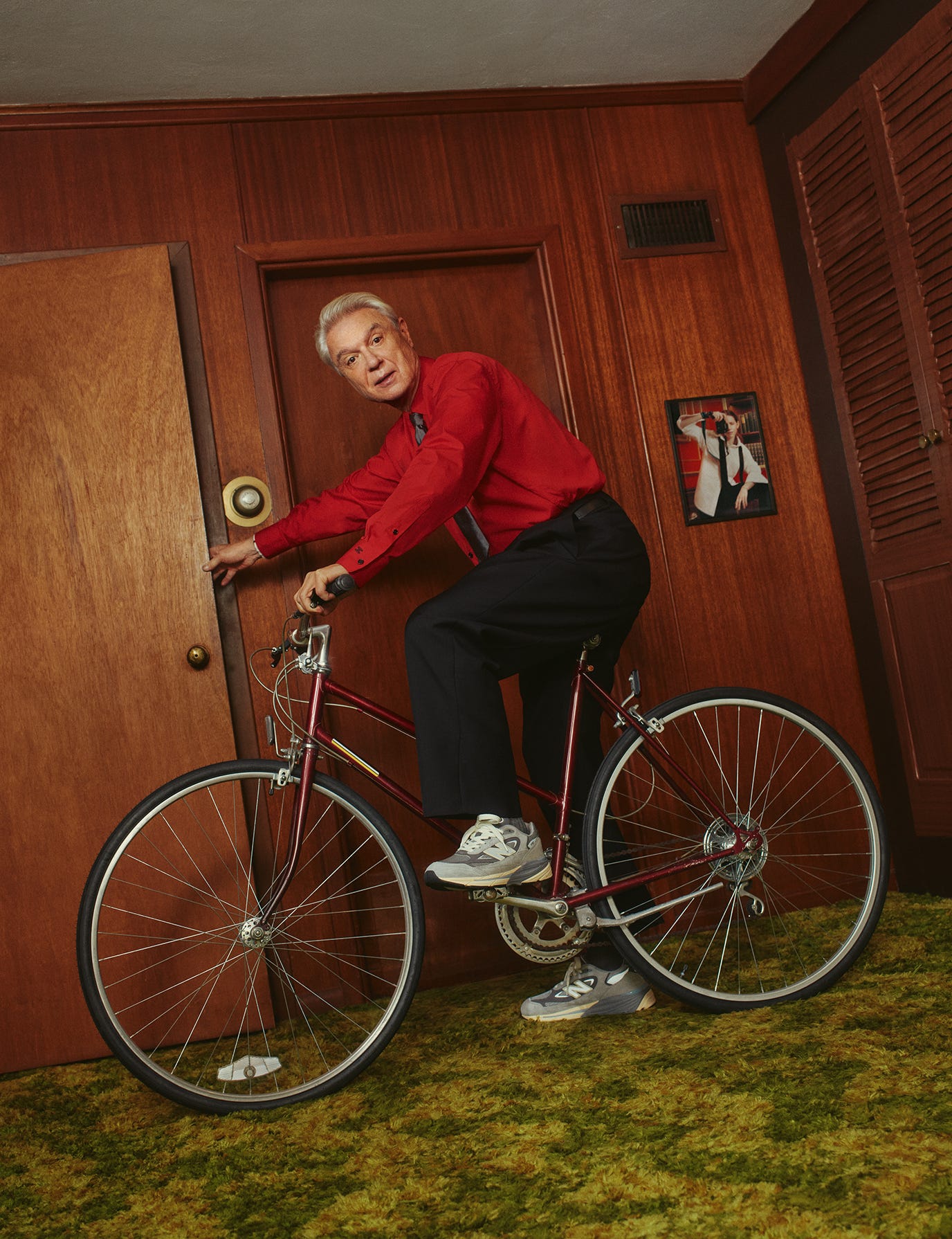
Every line was something you felt?
Absolutely.
How have you navigated the financial aspect of a creative career?
You’re a small business owner. Early on, I read one of those music biographies, where somebody was quoted—Muddy Waters maybe—as saying, “The artist who doesn’t pay attention to their business pretty soon doesn’t have any business.” And I thought, “Okay, I got to stay on top of it.” I got to not let my ego get carried away, with a video that’s going to cost a million dollars. You gotta keep it lean and mean. It’s not about making a fortune. I’m not ambitious where I need to build an empire.
Never been tempted to sell David Byrne skincare?
[Laughs] A year ago, I was in bed, talking with [my wife] Mala, and just said, “Look at these people, look how much money they’re making from all this stuff. Should I be doing this? It’s so easy!” She said, “No, no, David. What you do is different.”
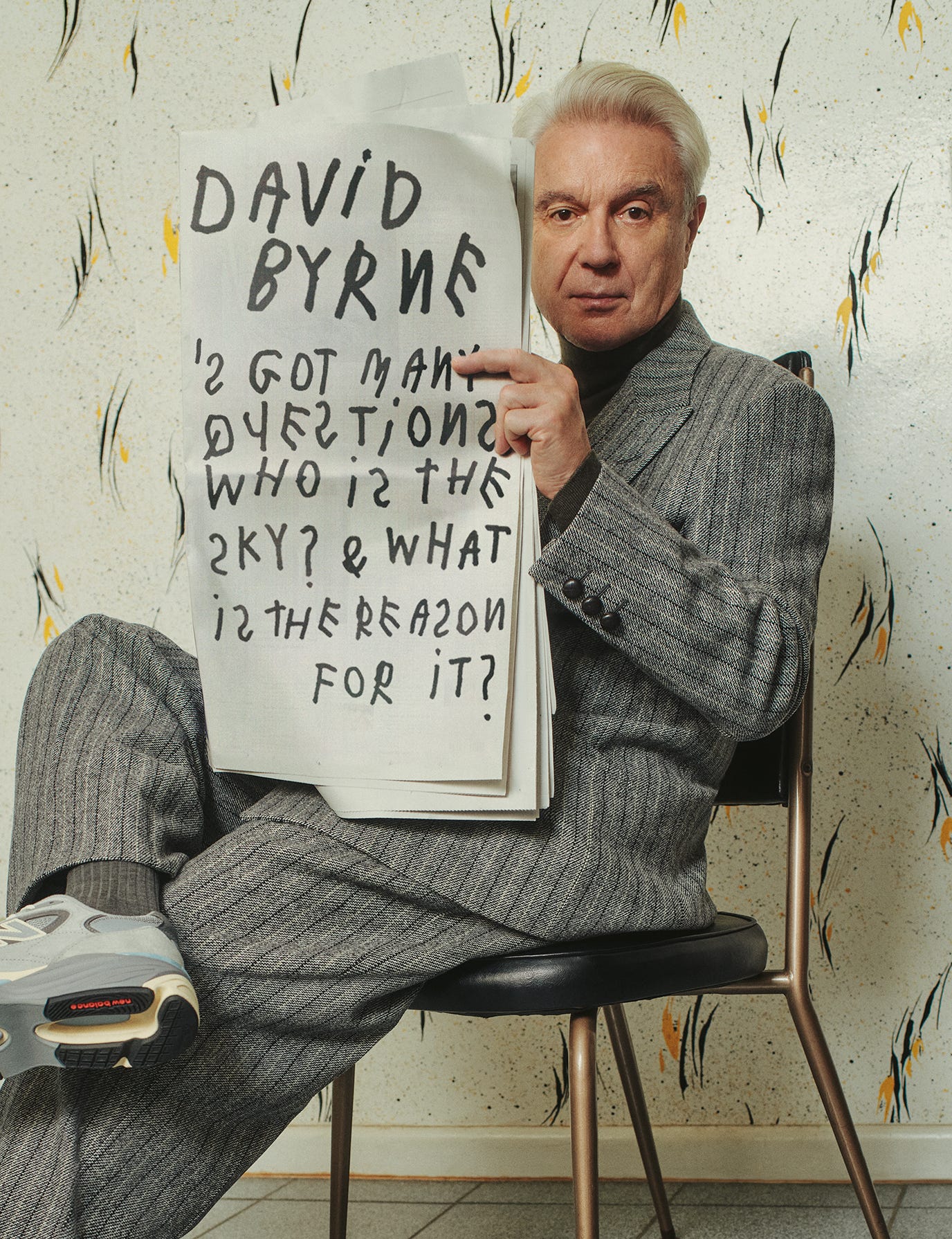
With the book, I almost read it as a rebuttal to AI—it’s so interested in the strange ingenuity of the human mind. What do you make of AI?
I like to think that certain aspects of AI can be used as a handy tool. If you’re analyzing spreadsheets and you want to see a pattern, AI might be good at that. I’ve read that it’s good for, like, skin doctors discovering the beginning of a melanoma, that the AI can pick it out sometimes better than a doctor can. If it’s trustworthy as a tool, that seems useful.
The other things that I’ve seen—it’s just completely ridiculous and scary. I've heard of students using it to write their papers, and then they end up with no knowledge of the thing they just wrote about. And I think, “Oh, it’s going to make people really stupid.” They’re going to think that this machine is going to do everything for us, which is part of the intention, I think.
Of course, there’s all the stuff we read about it breaking out of the sandbox and hacking into whatever, deceiving its masters. I could have predicted that. I’ve read enough science fiction. This was inevitable—and it’s not going to end well.
And yet I found the book hopeful, shining a light on people who had creative, human ideas. Are you hopeful?
It’s a struggle. We’re fighting an uphill battle because the human brain loves bad news. You’ll doom scroll through bad news forever. We’ve evolved to be aware of warnings: is that a tiger in the bush? I’m going to assume it is, and that way I won’t die.
But then there are little pockets of people doing really interesting things, solving problems. And that goes quite a ways to mitigate the stuff you read in the paper. It helps you realize: it’s not all gloom and doom. I’m optimistic that people will persevere.